Avalonia applications
Complete programs with an Avalonia window — calculators, converters, games, a notepad, an address book and a paint program.
Run one from its folder in samples/UsingDotNet/tests/packages/AvaloniaSamples/apps, for example cd Calculator and ring Calculator.ring; with --selftest it checks itself and closes. See the Avalonia guide for the concepts.
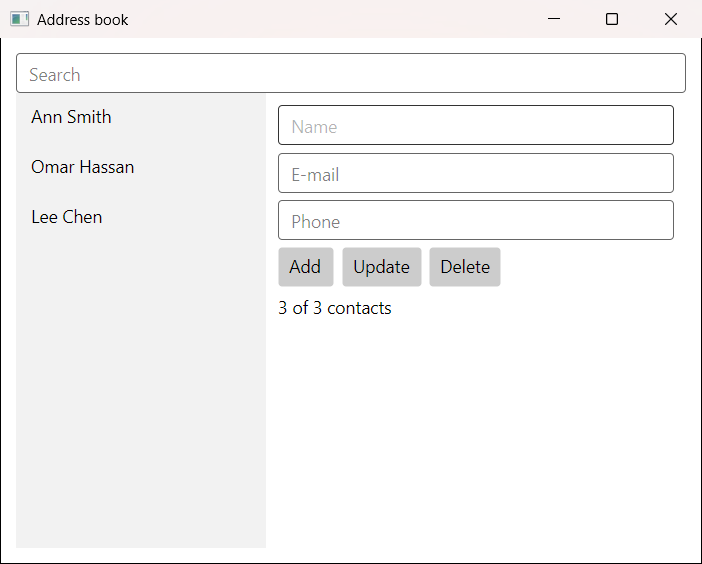
Address Book
An address book: a list of contacts with a search box and a form; add, change and delete contacts
cd samples/UsingDotNet/tests/packages/AvaloniaSamples/apps/AddressBook then ring AddressBook.ringSource code
# An address book: a list of contacts with a search box and a form; add, change and delete contacts

load "../../avalonia.ring"
avUse()

aContacts = [["Ann Smith","ann@example.com","555-0101"],["Omar Hassan","omar@example.com","555-0102"],["Lee Chen","lee@example.com","555-0103"]]
aShown = []          # the numbers of the contacts that the list shows

oWindow = avWindow("Address book",560,420)
oDock = new DockPanel()
oDock.Margin = avThickness(12)
oWindow.Content = oDock
oSearch = new TextBox()
oSearch.Watermark = "Search"
oSearch.setTextChangedEvent("showList()")
oDock.SetDock(oSearch,"Top")
oList = new ListBox()
oList.Width = 200
oList.setSelectionChangedEvent("selected()")
oDock.SetDock(oList,"Left")
oForm = avStack(6,10)
oName = new TextBox()
oName.Watermark = "Name"
oEmail = new TextBox()
oEmail.Watermark = "E-mail"
oPhone = new TextBox()
oPhone.Watermark = "Phone"
oMessage = avText("")
oButtons = avRow(6)
oButtons {
	Children.Add(avButton("Add","addContact()"))
	Children.Add(avButton("Update","updateContact()"))
	Children.Add(avButton("Delete","deleteContact()"))
}
oForm {
	Children.Add(oName)
	Children.Add(oEmail)
	Children.Add(oPhone)
	Children.Add(oButtons)
	Children.Add(oMessage)
}
oDock {
	Children.Add(oSearch)
	Children.Add(oList)
	Children.Add(oForm)
}
showList()

avRun(oWindow)

# --------------------------------------------------------------------------

func textOf oBox

	cText = oBox.Text
	if isstring(cText)
		return cText
	ok
	return ""

# the contacts that match the search text (in the name or the e-mail)
func showList

	if not isobject(oMessage)
		return
	ok
	cSearch = lower(textOf(oSearch))
	oList.Items.Clear()
	aShown = []
	for nContact = 1 to len(aContacts)
		if cSearch = "" or substr(lower(aContacts[nContact][1]),cSearch) > 0 or substr(lower(aContacts[nContact][2]),cSearch) > 0
			aShown + nContact
			oList.Items.Add(aContacts[nContact][1])
		ok
	next
	oMessage.Text = "" + len(aShown) + " of " + len(aContacts) + " contacts"

# the number of the contact that is selected (0 when none)
func current

	nLine = oList.SelectedIndex
	if nLine < 0 or nLine >= len(aShown)
		return 0
	ok
	return aShown[nLine + 1]

func selected

	nContact = current()
	if nContact > 0
		oName.Text = aContacts[nContact][1]
		oEmail.Text = aContacts[nContact][2]
		oPhone.Text = aContacts[nContact][3]
	ok

# a name and an e-mail with an @ are needed
func valid

	if textOf(oName) = ""
		oMessage.Text = "A name is needed"
		return False
	ok
	if substr(textOf(oEmail),"@") = 0
		oMessage.Text = "The e-mail needs an @"
		return False
	ok
	return True

func addContact

	if valid()
		aContacts + [textOf(oName),textOf(oEmail),textOf(oPhone)]
		showList()
		oMessage.Text = "Added " + textOf(oName)
	ok

func updateContact

	nContact = current()
	if nContact > 0 and valid()
		aContacts[nContact] = [textOf(oName),textOf(oEmail),textOf(oPhone)]
		showList()
		oMessage.Text = "Updated " + textOf(oName)
	ok

func deleteContact

	nContact = current()
	if nContact > 0
		del(aContacts,nContact)
		showList()
		oName.Text = ""
		oEmail.Text = ""
		oPhone.Text = ""
	ok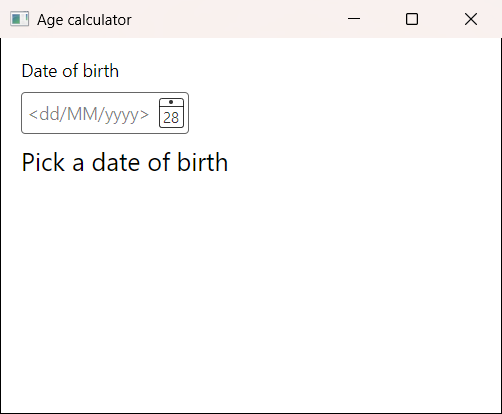
Age Calculator
Age calculator: the date of birth gives the age in years, months and days, the days lived and the days to the next birthday
cd samples/UsingDotNet/tests/packages/AvaloniaSamples/apps/AgeCalculator then ring AgeCalculator.ringSource code
# Age calculator: the date of birth gives the age in years, months and days, the days lived and the days to the next birthday

load "../../avalonia.ring"
avUse()

oWindow = avWindow("Age calculator",400,300)
oPanel = avStack(8,16)
oWindow.Content = oPanel
oBirth = new CalendarDatePicker()
oBirth.setSelectedDateChangedEvent("picked()")
oAge = avText("Pick a date of birth")
oAge.FontSize = 20
oDays = avText("")
oNext = avText("")
oPanel {
	Children.Add(avText("Date of birth"))
	Children.Add(oBirth)
	Children.Add(oAge)
	Children.Add(oDays)
	Children.Add(oNext)
}

avRun(oWindow)

# --------------------------------------------------------------------------

func isLeap nYear

	return (nYear % 4 = 0 and nYear % 100 != 0) or nYear % 400 = 0

func daysInMonth nYear, nMonth

	aDays = [31,28,31,30,31,30,31,31,30,31,30,31]
	if nMonth = 2 and isLeap(nYear)
		return 29
	ok
	return aDays[nMonth]

# the age between two dates [years, months, days]
func ageBetween nYear1, nMonth1, nDay1, nYear2, nMonth2, nDay2

	nYears = nYear2 - nYear1
	nMonths = nMonth2 - nMonth1
	nDays = nDay2 - nDay1
	if nDays < 0
		nMonths--
		nPreviousMonth = nMonth2 - 1
		nPreviousYear = nYear2
		if nPreviousMonth = 0
			nPreviousMonth = 12
			nPreviousYear--
		ok
		nDays += daysInMonth(nPreviousYear,nPreviousMonth)
	ok
	if nMonths < 0
		nYears--
		nMonths += 12
	ok
	return [nYears,nMonths,nDays]

# show the age at a date
func showAge oBirthDate, oToday

	aAge = ageBetween(oBirthDate.Year,oBirthDate.Month,oBirthDate.Day,oToday.Year,oToday.Month,oToday.Day)
	oAge.Text = "" + aAge[1] + " years, " + aAge[2] + " months, " + aAge[3] + " days"
	nLived = floor(oToday.Subtract(oBirthDate).TotalDays)
	oDays.Text = "" + nLived + " days lived"
	oBirthday = dnNew("System.DateTime",[oToday.Year,oBirthDate.Month,min(oBirthDate.Day,daysInMonth(oToday.Year,oBirthDate.Month))])
	if oBirthday.CompareTo(oToday) < 0
		oBirthday = dnNew("System.DateTime",[oToday.Year + 1,oBirthDate.Month,min(oBirthDate.Day,daysInMonth(oToday.Year + 1,oBirthDate.Month))])
	ok
	oNext.Text = "" + floor(oBirthday.Subtract(oToday).TotalDays) + " days to the next birthday"

func picked

	oDate = oBirth.SelectedDate
	if not oDate.isNull()
		showAge(oDate,dnStatic("System.DateTime","get_Today",[]))
	ok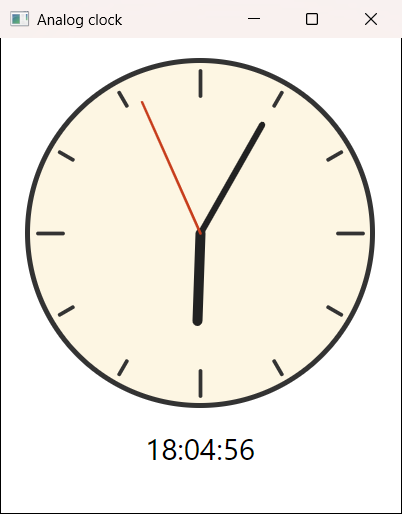
Analog Clock
An analog clock: a face with twelve marks and three hands (lines) that turn every second; the digital time is shown below
cd samples/UsingDotNet/tests/packages/AvaloniaSamples/apps/AnalogClock then ring AnalogClock.ringSource code
# An analog clock: a face with twelve marks and three hands (lines) that turn every second; the digital time is shown below

load "../../avalonia.ring"
avUse()

nCenter = 150
nRadius = 130

oWindow = avWindow("Analog clock",320,380)
oPanel = avStack(6,6)
oWindow.Content = oPanel
oCanvas = new Canvas()
oCanvas {
	Width = 300
	Height = 300
}
oFace = new Ellipse()
oFace {
	Width = nRadius * 2 + 20
	Height = nRadius * 2 + 20
	Fill = avBrush("#FDF6E3")
	Stroke = avBrush("#333333")
	StrokeThickness = 4
}
oCanvas.SetLeft(oFace,nCenter - nRadius - 10)
oCanvas.SetTop(oFace,nCenter - nRadius - 10)
oCanvas.Children.Add(oFace)
for nMark = 0 to 11
	nAngle = nMark * 30
	nLong = 12
	if nMark % 3 = 0
		nLong = 20
	ok
	oMark = hand(nAngle,nRadius - nLong,nRadius,"#333333",3)
	oCanvas.Children.Add(oMark)
next
oHour = hand(0,0,70,"#222222",8)
oMinute = hand(0,0,100,"#222222",5)
oSecond = hand(0,0,115,"#C73E1D",2)
oCanvas {
	Children.Add(oHour)
	Children.Add(oMinute)
	Children.Add(oSecond)
}
oDigital = avText("")
oDigital.FontSize = 24
oDigital.HorizontalAlignment = "Center"
oPanel {
	Children.Add(oCanvas)
	Children.Add(oDigital)
}
oTimer = new DispatcherTimer()
oTimer.Interval = dnStatic("System.TimeSpan","FromSeconds",[1])
oTimer.setTickEvent("tickNow()")
oTimer.Start()
tickNow()

avRun(oWindow)

# --------------------------------------------------------------------------

# a point on the circle of a radius: the angle goes clockwise from twelve o'clock, in degrees
func pointAt nAngle, nLength

	nRadians = nAngle * 3.14159265358979 / 180
	return [nCenter + nLength * sin(nRadians),nCenter - nLength * cos(nRadians)]

# a line at an angle from a distance of the center to another
func hand nAngle, nFrom, nTo, cColor, nThickness

	oLine = new Line()
	oLine.Stroke = avBrush(cColor)
	oLine.StrokeThickness = nThickness
	oLine.StrokeLineCap = "Round"
	setHand(oLine,nAngle,nFrom,nTo)
	return oLine

func setHand oLine, nAngle, nFrom, nTo

	aStart = pointAt(nAngle,nFrom)
	aEnd = pointAt(nAngle,nTo)
	oLine.StartPoint = (new Point).@New([ :x = aStart[1], :y = aStart[2] ])
	oLine.EndPoint = (new Point).@New([ :x = aEnd[1], :y = aEnd[2] ])

# the hands show a time
func showTime nHours, nMinutes, nSeconds

	setHand(oSecond,nSeconds * 6,0,115)
	setHand(oMinute,nMinutes * 6 + nSeconds / 10,0,100)
	setHand(oHour,(nHours % 12) * 30 + nMinutes / 2,0,70)
	oDigital.Text = two(nHours) + ":" + two(nMinutes) + ":" + two(nSeconds)

func two nNumber

	if nNumber < 10
		return "0" + nNumber
	ok
	return "" + nNumber

func tickNow

	oNow = dnStatic("System.DateTime","get_Now",[])
	showTime(oNow.Hour,oNow.Minute,oNow.Second)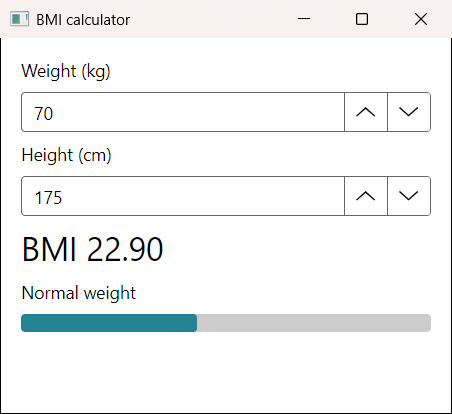
BMICalculator
Body mass index: the weight in kilograms and the height in centimeters give the index and its class
cd samples/UsingDotNet/tests/packages/AvaloniaSamples/apps/BMICalculator then ring BMICalculator.ringSource code
# Body mass index: the weight in kilograms and the height in centimeters give the index and its class

load "../../avalonia.ring"
avUse()

oWindow = avWindow("BMI calculator",360,300)
oPanel = avStack(8,16)
oWindow.Content = oPanel
oWeight = numberBox(70,20,300)
oHeight = numberBox(175,100,250)
oIndex = avText("")
oIndex.FontSize = 26
oClass = avText("")
oBar = new ProgressBar()
oBar {
	Minimum = 10
	Maximum = 40
	Height = 14
}
oPanel {
	Children.Add(avText("Weight (kg)"))
	Children.Add(oWeight)
	Children.Add(avText("Height (cm)"))
	Children.Add(oHeight)
	Children.Add(oIndex)
	Children.Add(oClass)
	Children.Add(oBar)
}
calculate()

avRun(oWindow)

# --------------------------------------------------------------------------

func numberBox nValue, nMinimum, nMaximum

	oBox = new NumericUpDown()
	oBox {
		Minimum = nMinimum
		Maximum = nMaximum
		Value = nValue
		setValueChangedEvent("calculate()")
	}
	return oBox

# the index: the weight divided by the square of the height in meters
func bmi nKilograms, nCentimeters

	nMeters = nCentimeters / 100
	return nKilograms / (nMeters * nMeters)

func classOf nIndex

	if nIndex < 18.5
		return "Underweight"
	but nIndex < 25
		return "Normal weight"
	but nIndex < 30
		return "Overweight"
	ok
	return "Obese"

func calculate

	if not isobject(oBar)
		return
	ok
	nIndex = bmi(oWeight.Value,oHeight.Value)
	oIndex.Text = "BMI " + (floor(nIndex * 10 + 0.5) / 10)
	oClass.Text = classOf(nIndex)
	oBar.Value = nIndex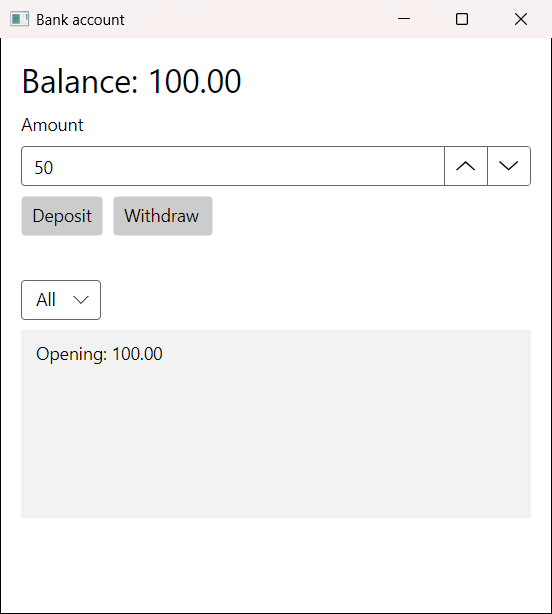
Bank Account
A bank account: deposits and withdrawals with a history; a withdrawal of more than the balance is refused; the history can be filtered
cd samples/UsingDotNet/tests/packages/AvaloniaSamples/apps/BankAccount then ring BankAccount.ringSource code
# A bank account: deposits and withdrawals with a history; a withdrawal of more than the balance is refused; the history can be filtered

load "../../avalonia.ring"
avUse()

nBalance = 100
aHistory = [["Opening",100]]          # [description, amount]: a deposit is positive, a withdrawal negative

oWindow = avWindow("Bank account",440,460)
oPanel = avStack(8,16)
oWindow.Content = oPanel
oBalance = avText("")
oBalance.FontSize = 26
oAmount = new NumericUpDown()
oAmount {
	Minimum = 0.01
	Maximum = 1000000
	Increment = 10
	Value = 50
}
oMessage = avText("")
oFilter = new ComboBox()
for cKind in ["All","Deposits","Withdrawals"]
	oFilter.Items.Add(cKind)
next
oFilter.SelectedIndex = 0
oFilter.setSelectionChangedEvent("showHistory()")
oList = new ListBox()
oList.Height = 150
oRow = avRow(8)
oRow {
	Children.Add(avButton("Deposit","deposit()"))
	Children.Add(avButton("Withdraw","withdraw()"))
}
oPanel {
	Children.Add(oBalance)
	Children.Add(avText("Amount"))
	Children.Add(oAmount)
	Children.Add(oRow)
	Children.Add(oMessage)
	Children.Add(oFilter)
	Children.Add(oList)
}
showHistory()

avRun(oWindow)

# --------------------------------------------------------------------------

# a number with two decimals
func money nValue

	nCents = floor(fabs(nValue) * 100 + 0.5)
	nRest = nCents % 100
	cRest = "" + nRest
	if nRest < 10
		cRest = "0" + nRest
	ok
	cSign = ""
	if nValue < 0
		cSign = "-"
	ok
	return cSign + floor(nCents / 100) + "." + cRest

func deposit

	nAmount = oAmount.Value
	if nAmount <= 0
		return
	ok
	nBalance += nAmount
	aHistory + ["Deposit",nAmount]
	oMessage.Text = "Deposited " + money(nAmount)
	showHistory()

func withdraw

	nAmount = oAmount.Value
	if nAmount > nBalance
		oMessage.Text = "Refused: the balance is only " + money(nBalance)
		return
	ok
	nBalance -= nAmount
	aHistory + ["Withdrawal",-nAmount]
	oMessage.Text = "Withdrew " + money(nAmount)
	showHistory()

func showHistory

	if not isobject(oList)
		return
	ok
	oBalance.Text = "Balance: " + money(nBalance)
	oList.Items.Clear()
	cFilter = "All"
	if oFilter.SelectedIndex >= 0
		cFilter = "" + oFilter.SelectedItem
	ok
	for aEntry in aHistory
		if cFilter = "All" or (cFilter = "Deposits" and aEntry[2] > 0) or (cFilter = "Withdrawals" and aEntry[2] < 0)
			oList.Items.Add(aEntry[1] + ": " + money(aEntry[2]))
		ok
	next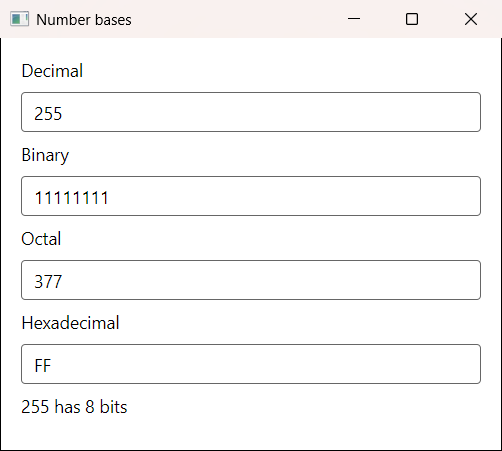
Binary Converter
Number bases: a whole number in decimal, binary, octal and hexadecimal; type in one box and the others follow
cd samples/UsingDotNet/tests/packages/AvaloniaSamples/apps/BinaryConverter then ring BinaryConverter.ringSource code
# Number bases: a whole number in decimal, binary, octal and hexadecimal; type in one box and the others follow

load "../../avalonia.ring"
avUse()

lBusy = False

oWindow = avWindow("Number bases",400,330)
oPanel = avStack(8,16)
oWindow.Content = oPanel
oDecimal = field(10)
oBinary = field(2)
oOctal = field(8)
oHex = field(16)
oState = avText("")
oPanel {
	Children.Add(avText("Decimal"))
	Children.Add(oDecimal)
	Children.Add(avText("Binary"))
	Children.Add(oBinary)
	Children.Add(avText("Octal"))
	Children.Add(oOctal)
	Children.Add(avText("Hexadecimal"))
	Children.Add(oHex)
	Children.Add(oState)
}
oDecimal.Text = "255"

avRun(oWindow)

# --------------------------------------------------------------------------

func field nBase

	oBox = new TextBox()
	oBox.setTextChangedEvent("typed(" + nBase + ")")
	return oBox

# the digits of a number in a base
func toBase nNumber, nBase

	if nNumber = 0
		return "0"
	ok
	cDigits = "0123456789ABCDEF"
	cText = ""
	while nNumber > 0
		cText = cDigits[nNumber % nBase + 1] + cText
		nNumber = floor(nNumber / nBase)
	end
	return cText

# the number of digits in a base, -1 when a character is not a digit of the base
func fromBase cText, nBase

	if cText = ""
		return -1
	ok
	cDigits = "0123456789ABCDEF"
	nNumber = 0
	for cChar in upper(cText)
		nDigit = substr(cDigits,cChar) - 1
		if nDigit < 0 or nDigit >= nBase
			return -1
		ok
		nNumber = nNumber * nBase + nDigit
	next
	return nNumber

func textOf oBox

	cText = oBox.Text
	if isstring(cText)
		return cText
	ok
	return ""

# a box was typed in: the others show the same number
func typed nBase

	if lBusy
		return
	ok
	switch nBase
	on 10
		cText = textOf(oDecimal)
	on 2
		cText = textOf(oBinary)
	on 8
		cText = textOf(oOctal)
	on 16
		cText = textOf(oHex)
	off
	nNumber = fromBase(cText,nBase)
	if nNumber < 0
		oState.Text = "Not a base " + nBase + " number"
		return
	ok
	lBusy = True
	if nBase != 10
		oDecimal.Text = "" + nNumber
	ok
	if nBase != 2
		oBinary.Text = toBase(nNumber,2)
	ok
	if nBase != 8
		oOctal.Text = toBase(nNumber,8)
	ok
	if nBase != 16
		oHex.Text = toBase(nNumber,16)
	ok
	lBusy = False
	oState.Text = "" + nNumber + " has " + len(toBase(nNumber,2)) + " bits"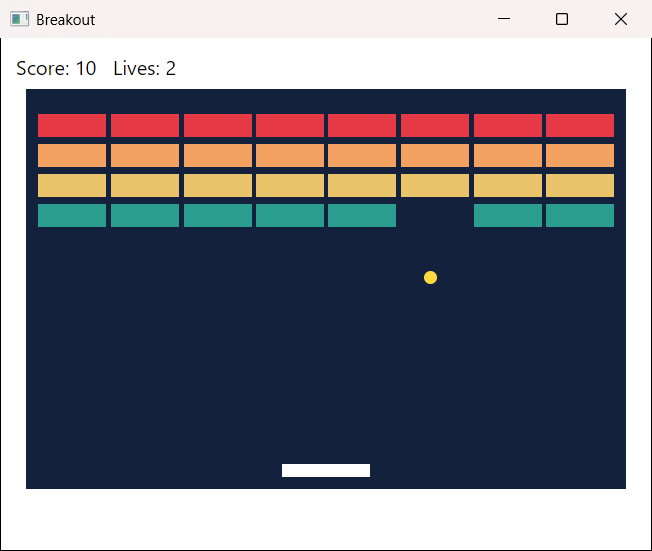
Breakout
Breakout: a ball breaks the bricks; the paddle follows the left and right keys (or A and D); three lives
cd samples/UsingDotNet/tests/packages/AvaloniaSamples/apps/Breakout then ring Breakout.ringSource code
# Breakout: a ball breaks the bricks; the paddle follows the left and right keys (or A and D); three lives

load "../../avalonia.ring"
avUse()

nWidth = 480
nHeight = 320
nPaddleWidth = 70
nPaddleX = 205
nBallX = 240
nBallY = 250
nSpeedX = 3
nSpeedY = -4
nLives = 3
nScore = 0
nRows = 4
nColumns = 8
aBricks = []          # [shape, alive]
lOver = False

oWindow = avWindow("Breakout",nWidth + 40,nHeight + 90)
oPanel = avStack(6,12)
oWindow.Content = oPanel
oInfo = avText("")
oInfo.FontSize = 16
oCanvas = new Canvas()
oCanvas {
	Width = nWidth
	Height = nHeight
	Background = avBrush("#14213D")
}
aColors = ["#E63946","#F4A261","#E9C46A","#2A9D8F"]
for nRow = 1 to nRows
	for nColumn = 1 to nColumns
		oBrick = new Rectangle()
		oBrick.Width = 54
		oBrick.Height = 18
		oBrick.Fill = avBrush(aColors[nRow])
		oCanvas.SetLeft(oBrick,10 + (nColumn - 1) * 58)
		oCanvas.SetTop(oBrick,20 + (nRow - 1) * 24)
		oCanvas.Children.Add(oBrick)
		aBricks + [oBrick,True]
	next
next
oPaddle = new Rectangle()
oPaddle.Width = nPaddleWidth
oPaddle.Height = 10
oPaddle.Fill = avBrush("White")
oBall = new Ellipse()
oBall.Width = 10
oBall.Height = 10
oBall.Fill = avBrush("#FFD93D")
oCanvas.Children.Add(oPaddle)
oCanvas.Children.Add(oBall)
oPanel {
	Children.Add(oInfo)
	Children.Add(oCanvas)
}
oWindow.setKeyDownEvent("keyDown(aDotNetArgs[2].Key)")
oTimer = new DispatcherTimer()
oTimer.Interval = dnStatic("System.TimeSpan","FromMilliseconds",[20])
oTimer.setTickEvent("tick()")
draw()
oTimer.Start()

avRun(oWindow)

# --------------------------------------------------------------------------

func keyDown cKey

	cKey = "" + cKey
	if cKey = "Left" or cKey = "A"
		nPaddleX = max(0,nPaddleX - 24)
	but cKey = "Right" or cKey = "D"
		nPaddleX = min(nWidth - nPaddleWidth,nPaddleX + 24)
	ok

func bricksLeft

	nCount = 0
	for aBrick in aBricks
		if aBrick[2]
			nCount++
		ok
	next
	return nCount

# a brick that the ball touches breaks and the ball turns back
func hitBricks

	for nBrick = 1 to len(aBricks)
		if aBricks[nBrick][2]
			nLeft = 10 + ((nBrick - 1) % nColumns) * 58
			nTop = 20 + floor((nBrick - 1) / nColumns) * 24
			if nBallX + 10 >= nLeft and nBallX <= nLeft + 54 and nBallY + 10 >= nTop and nBallY <= nTop + 18
				aBricks[nBrick][2] = False
				aBricks[nBrick][1].IsVisible = False
				nScore += 10
				nSpeedY = -nSpeedY
				return True
			ok
		ok
	next
	return False

func tick

	if lOver
		return
	ok
	nBallX += nSpeedX
	nBallY += nSpeedY
	if nBallX <= 0 or nBallX >= nWidth - 10
		nSpeedX = -nSpeedX
	ok
	if nBallY <= 0
		nSpeedY = -nSpeedY
	ok
	hitBricks()
	if nSpeedY > 0 and nBallY + 10 >= nHeight - 20 and nBallY <= nHeight - 8 and nBallX + 10 >= nPaddleX and nBallX <= nPaddleX + nPaddleWidth
		nSpeedY = -nSpeedY
		nSpeedX = (nBallX + 5 - (nPaddleX + nPaddleWidth / 2)) / 10
	ok
	if nBallY > nHeight
		nLives--
		nBallX = nWidth / 2
		nBallY = 250
		nSpeedX = 3
		nSpeedY = -4
		if nLives = 0
			lOver = True
		ok
	ok
	if bricksLeft() = 0
		lOver = True
	ok
	draw()

func draw

	oCanvas.SetLeft(oPaddle,nPaddleX)
	oCanvas.SetTop(oPaddle,nHeight - 20)
	oCanvas.SetLeft(oBall,nBallX)
	oCanvas.SetTop(oBall,nBallY)
	if lOver and bricksLeft() = 0
		oInfo.Text = "You won! Score: " + nScore
	but lOver
		oInfo.Text = "Game over. Score: " + nScore
	else
		oInfo.Text = "Score: " + nScore + "   Lives: " + nLives
	ok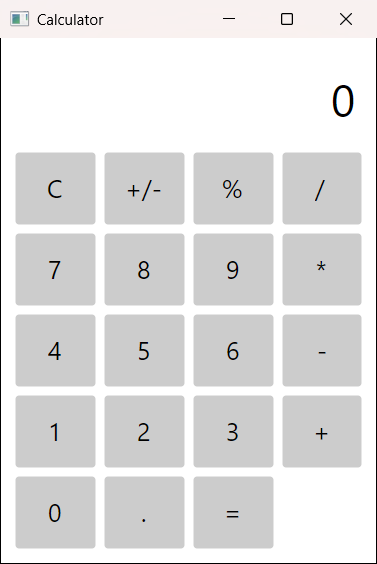
Calculator
A calculator: a display and a grid of buttons; each button calls press() with its key
cd samples/UsingDotNet/tests/packages/AvaloniaSamples/apps/Calculator then ring Calculator.ringSource code
# A calculator: a display and a grid of buttons; each button calls press() with its key

load "../../avalonia.ring"
avUse()

cDisplay = "0"
nLeft = 0
cOperator = ""
lNew = True          # the next digit starts a new number

oWindow = avWindow("Calculator",300,420)
oGrid = new Grid()
oGrid.Margin = avThickness(8)
oGrid.RowDefinitions = (new RowDefinitions).Parse("80,*,*,*,*,*")
oGrid.ColumnDefinitions = (new ColumnDefinitions).Parse("*,*,*,*")
oWindow.Content = oGrid

oScreen = new TextBlock()
oScreen {
	Text = "0"
	FontSize = 36
	HorizontalAlignment = "Right"
	VerticalAlignment = "Center"
	Margin = avThickness(8)
}
oGrid.SetColumnSpan(oScreen,4)
oGrid.Children.Add(oScreen)

aKeys = [
	["C","+/-","%","/"],
	["7","8","9","*"],
	["4","5","6","-"],
	["1","2","3","+"],
	["0",".","=",""]
]
nRows = len(aKeys)
for nRow = 1 to nRows
	for nColumn = 1 to 4
		cKey = aKeys[nRow][nColumn]
		if cKey != ""
			oKey = avButton(cKey,'press("' + cKey + '")')
			oKey.HorizontalAlignment = "Stretch"
			oKey.VerticalAlignment = "Stretch"
			oKey.HorizontalContentAlignment = "Center"
			oKey.VerticalContentAlignment = "Center"
			oKey.FontSize = 20
			oKey.Margin = avThickness(3)
			oGrid.SetRow(oKey,nRow)
			oGrid.SetColumn(oKey,nColumn - 1)
			oGrid.Children.Add(oKey)
		ok
	next
next

avRun(oWindow)

# --------------------------------------------------------------------------

# a key of the calculator
func press cKey

	if isdigit(cKey)
		if lNew or cDisplay = "0"
			cDisplay = cKey
		else
			cDisplay += cKey
		ok
		lNew = False
	but cKey = "."
		if lNew
			cDisplay = "0."
			lNew = False
		but substr(cDisplay,".") = 0
			cDisplay += "."
		ok
	but cKey = "C"
		cDisplay = "0"
		nLeft = 0
		cOperator = ""
		lNew = True
	but cKey = "+/-"
		if left(cDisplay,1) = "-"
			cDisplay = substr(cDisplay,2)
		but cDisplay != "0"
			cDisplay = "-" + cDisplay
		ok
	but cKey = "%"
		cDisplay = shown(number(cDisplay) / 100)
		lNew = True
	but cKey = "="
		calculate()
		cOperator = ""
		lNew = True
	else
		# + - * /
		if cOperator != "" and not lNew
			calculate()
		ok
		nLeft = number(cDisplay)
		cOperator = cKey
		lNew = True
	ok
	oScreen.Text = cDisplay

# the pending operation: nLeft cOperator the display
func calculate

	if cOperator = ""
		return
	ok
	nRight = number(cDisplay)
	switch cOperator
	on "+"
		nResult = nLeft + nRight
	on "-"
		nResult = nLeft - nRight
	on "*"
		nResult = nLeft * nRight
	on "/"
		if nRight = 0
			cDisplay = "Error"
			cOperator = ""
			return
		ok
		nResult = nLeft / nRight
	off
	cDisplay = shown(nResult)
	nLeft = nResult

# a number as text: whole numbers without decimals, the others with up to 10 decimals and no zeros at the end
func shown nValue

	if nValue = floor(nValue)
		return "" + floor(nValue)
	ok
	decimals(10)
	cText = "" + nValue
	decimals(2)
	while right(cText,1) = "0"
		cText = left(cText,len(cText) - 1)
	end
	if right(cText,1) = "."
		cText = left(cText,len(cText) - 1)
	ok
	return cText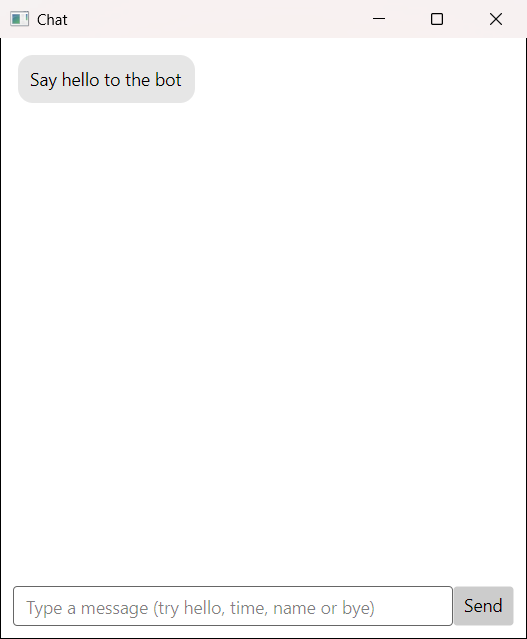
Chat Bubbles
A chat with bubbles: your messages on the right, the replies of a simple bot on the left; the list scrolls to the last message
cd samples/UsingDotNet/tests/packages/AvaloniaSamples/apps/ChatBubbles then ring ChatBubbles.ringSource code
# A chat with bubbles: your messages on the right, the replies of a simple bot on the left; the list scrolls to the last message

load "../../avalonia.ring"
avUse()

aReplies = [["hello","Hello! How can I help?"],["time","I do not have a clock, but your computer has one."],["name","I am a small bot written in Ring."],["bye","Goodbye!"]]
nMessages = 0

oWindow = avWindow("Chat",420,480)
oDock = new DockPanel()
oDock.Margin = avThickness(10)
oWindow.Content = oDock
oRow = new DockPanel()
oSend = avButton("Send","send()")
oRow.SetDock(oSend,"Right")
oInput = new TextBox()
oInput.Watermark = "Type a message (try hello, time, name or bye)"
oRow {
	Children.Add(oSend)
	Children.Add(oInput)
}
oDock.SetDock(oRow,"Bottom")
oScroll = new ScrollViewer()
oMessages = avStack(6,4)
oScroll.Content = oMessages
oDock {
	Children.Add(oRow)
	Children.Add(oScroll)
}
bubble("Say hello to the bot",False)

avRun(oWindow)

# --------------------------------------------------------------------------

# a bubble with a text, on the right for the user and on the left for the bot
func bubble cText, lUser

	oBubble = new Border()
	oBubble.CornerRadius = (new CornerRadius).Parse("12")
	oBubble.Padding = avThickness(10)
	oBubble.MaxWidth = 280
	oText = avText(cText)
	oText.TextWrapping = "Wrap"
	if lUser
		oBubble.Background = avBrush("#2E86AB")
		oBubble.HorizontalAlignment = "Right"
		oText.Foreground = avBrush("White")
	else
		oBubble.Background = avBrush("#E6E6E6")
		oBubble.HorizontalAlignment = "Left"
	ok
	oBubble.Child = oText
	oMessages.Children.Add(oBubble)
	nMessages++
	oScroll.ScrollToEnd()

# the answer of the bot: the first reply whose key word is in the message
func answerTo cText

	cLower = lower(cText)
	for aReply in aReplies
		if substr(cLower,aReply[1]) > 0
			return aReply[2]
		ok
	next
	return "I do not understand: " + cText

func send

	cText = oInput.Text
	if not isstring(cText) or trim(cText) = ""
		return
	ok
	bubble(trim(cText),True)
	bubble(answerTo(cText),False)
	oInput.Text = ""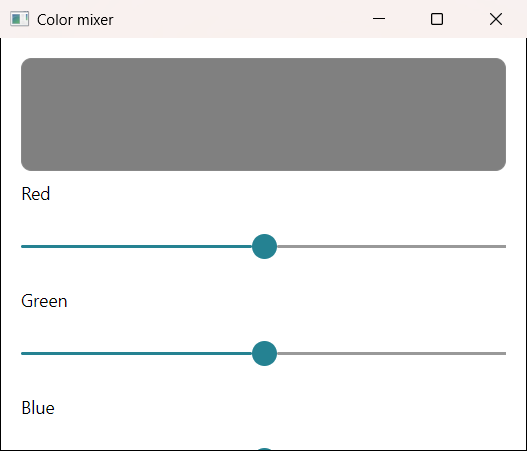
Color Mixer
A color mixer: three sliders make a color, a rectangle shows it, its code is written as text; a code that is typed moves the sliders
cd samples/UsingDotNet/tests/packages/AvaloniaSamples/apps/ColorMixer then ring ColorMixer.ringSource code
# A color mixer: three sliders make a color, a rectangle shows it, its code is written as text; a code that is typed moves the sliders

load "../../avalonia.ring"
avUse()

oWindow = avWindow("Color mixer",420,330)
oPanel = new StackPanel()
oPanel {
	Spacing = 8
	Margin = avThickness(16)
}
oWindow.Content = oPanel

oPreview = new Border()
oPreview {
	Height = 90
	CornerRadius = (new CornerRadius).Parse("8")
	BorderBrush = avBrush("#888888")
	BorderThickness = avThickness(1)
}
oPanel.Children.Add(oPreview)

oRed = channel("Red")
oGreen = channel("Green")
oBlue = channel("Blue")

oCode = new TextBox()
oCode {
	Watermark = "#RRGGBB"
	Width = 140
	HorizontalAlignment = "Left"
}
oCode.setTextChangedEvent("typed()")
oRow = new StackPanel()
oRow {
	Orientation = "Horizontal"
	Spacing = 8
}
oRow {
	Children.Add(avText("Code:"))
	Children.Add(oCode)
	Children.Add(avButton("Random","randomColor()"))
	Children.Add(avButton("Gray","gray()"))
}
oPanel.Children.Add(oRow)
lBusy = False
mix()

avRun(oWindow)

# --------------------------------------------------------------------------

# a slider from 0 to 255 with a name; it changes the color when it moves
func channel cName

	oLabel = avText(cName)
	oSlider = new Slider()
	oSlider {
		Minimum = 0
		Maximum = 255
		Value = 128
		setValueChangedEvent("mix()")
	}
	oPanel.Children.Add(oLabel)
	oPanel.Children.Add(oSlider)
	return oSlider

# the color of the three sliders: the rectangle and the code
func mix

	if lBusy
		return
	ok
	lBusy = True
	cHex = hex2(floor(oRed.Value)) + hex2(floor(oGreen.Value)) + hex2(floor(oBlue.Value))
	oPreview.Background = avBrush("#" + cHex)
	oCode.Text = "#" + cHex
	lBusy = False

# two hexadecimal digits
func hex2 nValue

	cDigits = "0123456789ABCDEF"
	return cDigits[floor(nValue / 16) + 1] + cDigits[nValue % 16 + 1]

# the code that was typed (when it is a whole code the sliders follow it)
func typed

	if lBusy
		return
	ok
	cText = oCode.Text
	if not isstring(cText) or len(cText) != 7 or left(cText,1) != "#"
		return
	ok
	lBusy = True
	oRed.Value = hex2num(substr(cText,2,2))
	oGreen.Value = hex2num(substr(cText,4,2))
	oBlue.Value = hex2num(substr(cText,6,2))
	oPreview.Background = avBrush(cText)
	lBusy = False

# a whole number from hexadecimal digits
func hex2num cText

	nValue = 0
	cDigits = "0123456789ABCDEF"
	for cChar in upper(cText)
		nPos = substr(cDigits,cChar)
		if nPos = 0
			return 0
		ok
		nValue = nValue * 16 + nPos - 1
	next
	return nValue

func randomColor

	oRed.Value = random(255)
	oGreen.Value = random(255)
	oBlue.Value = random(255)

func gray

	oRed.Value = 128
	oGreen.Value = 128
	oBlue.Value = 128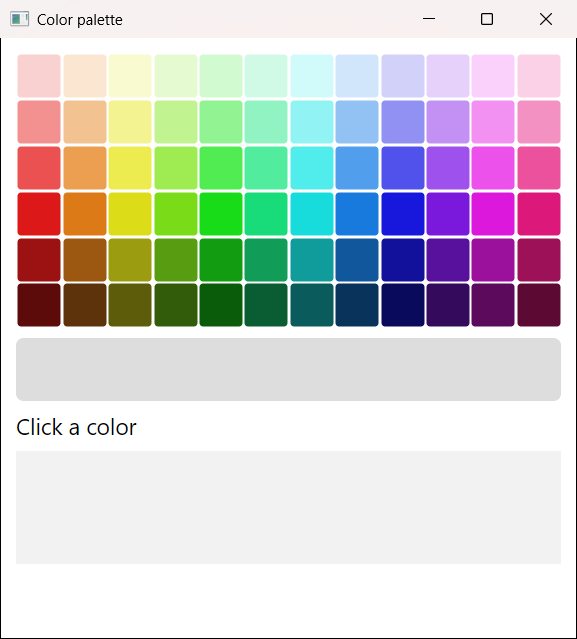
Color Palette
Color palette: a grid of colors made from hue, saturation and lightness; a click shows the code and the RGB values and adds the color to a history
cd samples/UsingDotNet/tests/packages/AvaloniaSamples/apps/ColorPalette then ring ColorPalette.ringSource code
# Color palette: a grid of colors made from hue, saturation and lightness; a click shows the code and the RGB values and adds the color to a history

load "../../avalonia.ring"
avUse()

nHues = 12
nShades = 6
aHistory = []
cCurrent = ""

oWindow = avWindow("Color palette",460,480)
oPanel = avStack(8,12)
oWindow.Content = oPanel
oGrid = new UniformGrid()
oGrid.Columns = nHues
oGrid.Rows = nShades
oGrid.Height = 220
aSwatches = []
for nShade = 1 to nShades
	for nHue = 1 to nHues
		cColor = colorAt(nHue,nShade)
		oSwatch = avButton("","pick('" + cColor + "')")
		oSwatch {
			HorizontalAlignment = "Stretch"
			VerticalAlignment = "Stretch"
			Margin = avThickness(1)
			Background = avBrush(cColor)
		}
		aSwatches + oSwatch
		oGrid.Children.Add(oSwatch)
	next
next
oPreview = new Border()
oPreview {
	Height = 50
	CornerRadius = (new CornerRadius).Parse("6")
	Background = avBrush("#DDDDDD")
}
oCode = avText("Click a color")
oCode.FontSize = 18
oHistory = new ListBox()
oHistory.Height = 90
oPanel {
	Children.Add(oGrid)
	Children.Add(oPreview)
	Children.Add(oCode)
	Children.Add(oHistory)
}

avRun(oWindow)

# --------------------------------------------------------------------------

# two hexadecimal digits
func hex2 nValue

	cDigits = "0123456789ABCDEF"
	nValue = floor(nValue + 0.5)
	return cDigits[floor(nValue / 16) + 1] + cDigits[nValue % 16 + 1]

# the code of a color from hue (0 to 360), saturation and lightness (0 to 1)
func hslToCode nHue, nSaturation, nLightness

	nC = (1 - fabs(2 * nLightness - 1)) * nSaturation
	nHuePart = nHue / 60
	nX = nC * (1 - fabs((nHuePart % 2) - 1))
	nM = nLightness - nC / 2
	nR = 0
	nG = 0
	nB = 0
	if nHuePart < 1
		nR = nC
		nG = nX
	but nHuePart < 2
		nR = nX
		nG = nC
	but nHuePart < 3
		nG = nC
		nB = nX
	but nHuePart < 4
		nG = nX
		nB = nC
	but nHuePart < 5
		nR = nX
		nB = nC
	else
		nR = nC
		nB = nX
	ok
	return "#" + hex2((nR + nM) * 255) + hex2((nG + nM) * 255) + hex2((nB + nM) * 255)

# the color of a swatch: the hue by column, the lightness by row
func colorAt nHue, nShade

	return hslToCode((nHue - 1) * 360 / nHues,0.8,0.9 - (nShade - 1) * 0.14)

func pick cColor

	cCurrent = cColor
	oPreview.Background = avBrush(cColor)
	oCode.Text = cColor + "   " + rgbText(cColor)
	if find(aHistory,cColor) = 0
		aHistory + cColor
		oHistory.Items.Add(cColor)
	ok

func rgbText cColor

	oColor = (new Color).Parse(cColor)
	return "rgb(" + oColor.R + ", " + oColor.G + ", " + oColor.B + ")"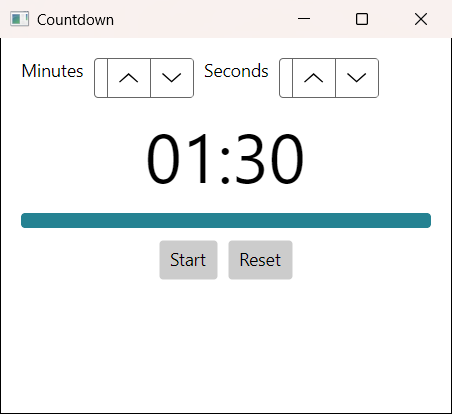
Countdown
Countdown: set minutes and seconds, start, pause and reset; the timer ticks every second and the bar shows what is left
cd samples/UsingDotNet/tests/packages/AvaloniaSamples/apps/Countdown then ring Countdown.ringSource code
# Countdown: set minutes and seconds, start, pause and reset; the timer ticks every second and the bar shows what is left

load "../../avalonia.ring"
avUse()

nTotal = 0          # the seconds at the start
nLeft = 0           # the seconds that are left

oWindow = avWindow("Countdown",360,300)
oPanel = avStack(10,16)
oWindow.Content = oPanel
oMinutes = box(1,0,99)
oSeconds = box(30,0,59)
oDisplay = avText("01:30")
oDisplay.FontSize = 54
oDisplay.HorizontalAlignment = "Center"
oBar = new ProgressBar()
oBar {
	Minimum = 0
	Maximum = 100
	Height = 12
}
oStart = avButton("Start","startPause()")
oReset = avButton("Reset","reset()")
oRow = avRow(8)
oRow {
	Children.Add(avText("Minutes"))
	Children.Add(oMinutes)
	Children.Add(avText("Seconds"))
	Children.Add(oSeconds)
}
oButtons = avRow(8)
oButtons.HorizontalAlignment = "Center"
oButtons {
	Children.Add(oStart)
	Children.Add(oReset)
}
oPanel {
	Children.Add(oRow)
	Children.Add(oDisplay)
	Children.Add(oBar)
	Children.Add(oButtons)
}
oTimer = new DispatcherTimer()
oTimer.Interval = dnStatic("System.TimeSpan","FromSeconds",[1])
oTimer.setTickEvent("tick()")
reset()

avRun(oWindow)

# --------------------------------------------------------------------------

func box nValue, nMinimum, nMaximum

	oBox = new NumericUpDown()
	oBox {
		Minimum = nMinimum
		Maximum = nMaximum
		Value = nValue
		Width = 80
		setValueChangedEvent("reset()")
	}
	return oBox

func two nNumber

	if nNumber < 10
		return "0" + nNumber
	ok
	return "" + nNumber

# seconds as minutes:seconds
func clock nSeconds

	return two(floor(nSeconds / 60)) + ":" + two(nSeconds % 60)

func show

	oDisplay.Text = clock(nLeft)
	if nTotal > 0
		oBar.Value = nLeft * 100 / nTotal
	else
		oBar.Value = 0
	ok

func reset

	if not isobject(oStart)
		return
	ok
	oTimer.Stop()
	oStart.Content = "Start"
	nTotal = floor(oMinutes.Value) * 60 + floor(oSeconds.Value)
	nLeft = nTotal
	show()

func startPause

	if oTimer.IsEnabled
		oTimer.Stop()
		oStart.Content = "Resume"
	but nLeft > 0
		oTimer.Start()
		oStart.Content = "Pause"
	ok

func tick

	if nLeft > 0
		nLeft--
	ok
	show()
	if nLeft = 0
		oTimer.Stop()
		oStart.Content = "Start"
		oDisplay.Text = "Time is up!"
	ok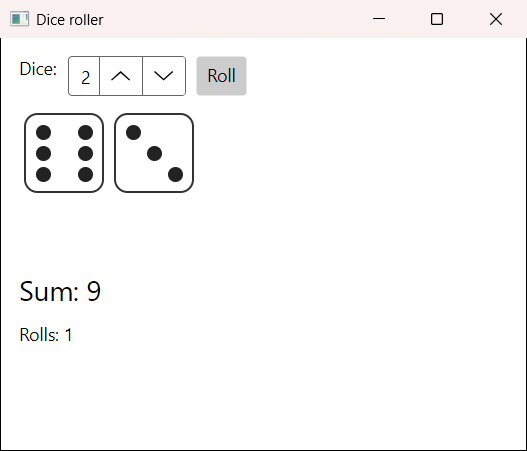
Dice Roller
Dice roller: roll one to six dice (the dots are drawn with ellipses), the sum is shown and the rolls are counted
cd samples/UsingDotNet/tests/packages/AvaloniaSamples/apps/DiceRoller then ring DiceRoller.ringSource code
# Dice roller: roll one to six dice (the dots are drawn with ellipses), the sum is shown and the rolls are counted

load "../../avalonia.ring"
avUse()

aDice = []          # the values of the dice
aDots = [[],[5],[1,9],[1,5,9],[1,3,7,9],[1,3,5,7,9],[1,3,4,6,7,9]]          # the dots of a die: cells 1 to 9 of a 3 x 3 grid (the index is the value + 1)
nRolls = 0

oWindow = avWindow("Dice roller",420,330)
oPanel = avStack(10,14)
oWindow.Content = oPanel
oCount = new NumericUpDown()
oCount {
	Minimum = 1
	Maximum = 6
	Value = 2
}
oTable = new WrapPanel()
oTable.Height = 120
oSum = avText("")
oSum.FontSize = 22
oRolled = avText("Rolls: 0")
oBar = avRow(8)
oBar {
	Children.Add(avText("Dice:"))
	Children.Add(oCount)
	Children.Add(avButton("Roll","roll()"))
}
oPanel {
	Children.Add(oBar)
	Children.Add(oTable)
	Children.Add(oSum)
	Children.Add(oRolled)
}
roll()

avRun(oWindow)

# --------------------------------------------------------------------------

func roll

	nDice = floor(oCount.Value)
	aDice = []
	for nDie = 1 to nDice
		aDice + (random(5) + 1)
	next
	nRolls++
	show()

# the dice on the table, the sum and the number of rolls
func show

	oTable.Children.Clear()
	nSum = 0
	for nValue in aDice
		oTable.Children.Add(dieView(nValue))
		nSum += nValue
	next
	oSum.Text = "Sum: " + nSum
	oRolled.Text = "Rolls: " + nRolls

# a white square with the dots of a value
func dieView nValue

	oBorder = new Border()
	oBorder {
		Width = 64
		Height = 64
		Margin = avThickness(4)
		Background = avBrush("White")
		BorderBrush = avBrush("#333333")
		BorderThickness = avThickness(2)
		CornerRadius = (new CornerRadius).Parse("10")
	}
	oCanvas = new Canvas()
	for nCell in aDots[nValue + 1]
		oDot = new Ellipse()
		oDot.Width = 12
		oDot.Height = 12
		oDot.Fill = avBrush("#222222")
		oCanvas.SetLeft(oDot,8 + ((nCell - 1) % 3) * 17)
		oCanvas.SetTop(oDot,8 + floor((nCell - 1) / 3) * 17)
		oCanvas.Children.Add(oDot)
	next
	oBorder.Child = oCanvas
	return oBorder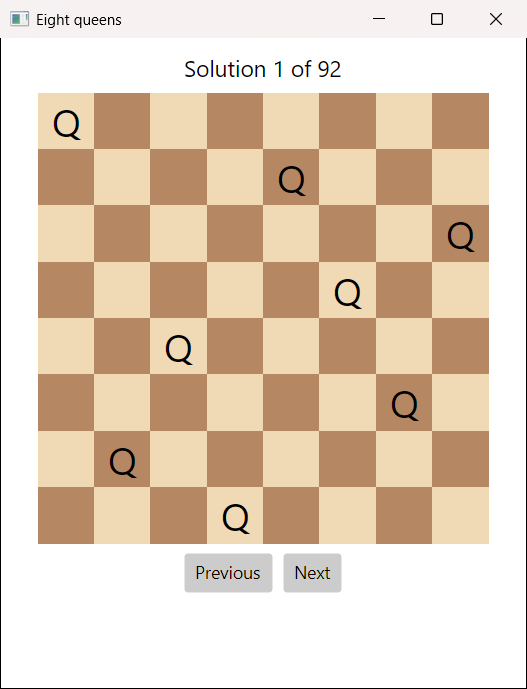
Eight Queens
Eight queens: a chess board where the program finds every way to put eight queens that do not attack each other; browse the 92 solutions
cd samples/UsingDotNet/tests/packages/AvaloniaSamples/apps/EightQueens then ring EightQueens.ringSource code
# Eight queens: a chess board where the program finds every way to put eight queens that do not attack each other; browse the 92 solutions

load "../../avalonia.ring"
avUse()

nSize = 8
aSolutions = []          # each solution is a list of the columns of the queens, one for each row
nCurrent = 1

oWindow = avWindow("Eight queens",420,520)
oPanel = avStack(8,12)
oWindow.Content = oPanel
oInfo = avText("")
oInfo.FontSize = 18
oInfo.HorizontalAlignment = "Center"
oBoard = new UniformGrid()
oBoard.Columns = nSize
oBoard.Rows = nSize
oBoard.Width = 360
oBoard.Height = 360
aSquares = []
for nSquare = 1 to nSize * nSize
	nRow = floor((nSquare - 1) / nSize)
	nColumn = (nSquare - 1) % nSize
	oSquare = new Border()
	if (nRow + nColumn) % 2 = 0
		oSquare.Background = avBrush("#F0D9B5")
	else
		oSquare.Background = avBrush("#B58863")
	ok
	oText = avText("")
	oText.FontSize = 30
	oText.HorizontalAlignment = "Center"
	oText.VerticalAlignment = "Center"
	oSquare.Child = oText
	aSquares + oSquare
	oBoard.Children.Add(oSquare)
next
oBar = avRow(8)
oBar.HorizontalAlignment = "Center"
oBar {
	Children.Add(avButton("Previous","previousSolution()"))
	Children.Add(avButton("Next","nextSolution()"))
}
oPanel {
	Children.Add(oInfo)
	Children.Add(oBoard)
	Children.Add(oBar)
}
solve(1,[])
showSolution()

avRun(oWindow)

# --------------------------------------------------------------------------

# a queen in a column of the next row is safe when no queen of the rows above is in its column or on a diagonal
func isSafe aQueens, nColumn

	nRow = len(aQueens) + 1
	for nOther = 1 to len(aQueens)
		if aQueens[nOther] = nColumn or fabs(aQueens[nOther] - nColumn) = nRow - nOther
			return False
		ok
	next
	return True

# the rows are filled one after the other; a full board is a solution
func solve nRow, aQueens

	if nRow > nSize
		aSolutions + aQueens
		return
	ok
	for nColumn = 1 to nSize
		if isSafe(aQueens,nColumn)
			aNext = aQueens
			aNext + nColumn
			solve(nRow + 1,aNext)
		ok
	next

func showSolution

	aQueens = aSolutions[nCurrent]
	for nSquare = 1 to nSize * nSize
		aSquares[nSquare].Child.Text = ""
	next
	for nRow = 1 to nSize
		aSquares[(nRow - 1) * nSize + aQueens[nRow]].Child.Text = "Q"
	next
	oInfo.Text = "Solution " + nCurrent + " of " + len(aSolutions)

func nextSolution

	nCurrent++
	if nCurrent > len(aSolutions)
		nCurrent = 1
	ok
	showSolution()

func previousSolution

	nCurrent--
	if nCurrent < 1
		nCurrent = len(aSolutions)
	ok
	showSolution()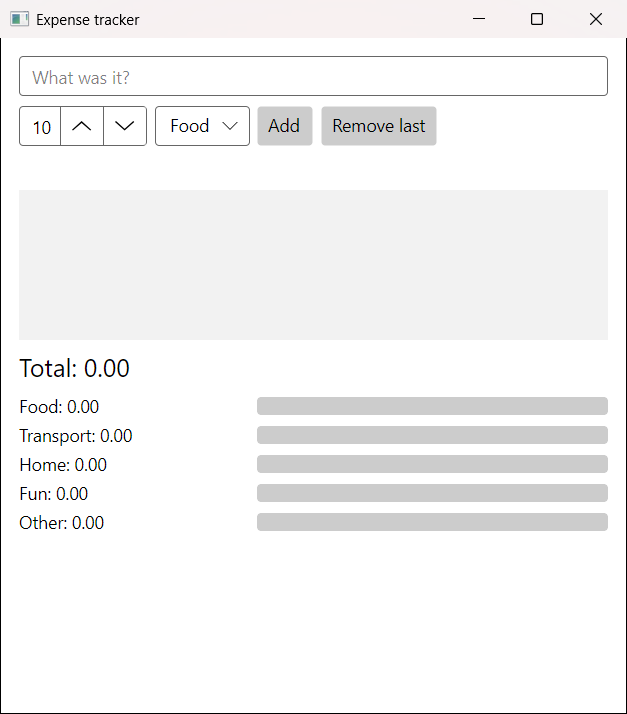
Expense Tracker
Expense tracker: add expenses with a category; the total, the total of each category and a bar for each category are shown
cd samples/UsingDotNet/tests/packages/AvaloniaSamples/apps/ExpenseTracker then ring ExpenseTracker.ringSource code
# Expense tracker: add expenses with a category; the total, the total of each category and a bar for each category are shown

load "../../avalonia.ring"
avUse()

aCategories = ["Food","Transport","Home","Fun","Other"]
aExpenses = []          # [description, category number, amount]

oWindow = avWindow("Expense tracker",500,540)
oPanel = avStack(8,14)
oWindow.Content = oPanel
oDescription = new TextBox()
oDescription.Watermark = "What was it?"
oAmount = new NumericUpDown()
oAmount {
	Minimum = 0.01
	Maximum = 1000000
	Increment = 1
	Value = 10
}
oCategory = new ComboBox()
for cName in aCategories
	oCategory.Items.Add(cName)
next
oCategory.SelectedIndex = 0
oMessage = avText("")
oList = new ListBox()
oList.Height = 120
oTotal = avText("")
oTotal.FontSize = 20
oBars = avStack(4,0)
aBars = []
aTexts = []
for nCategory = 1 to len(aCategories)
	oRow = new DockPanel()
	oLabel = avText("")
	oLabel.Width = 190
	oBar = new ProgressBar()
	oBar {
		Minimum = 0
		Maximum = 100
		Height = 14
	}
	oRow.SetDock(oLabel,"Left")
	oRow.Children.Add(oLabel)
	oRow.Children.Add(oBar)
	aTexts + oLabel
	aBars + oBar
	oBars.Children.Add(oRow)
next
oRowAdd = avRow(6)
oRowAdd {
	Children.Add(oAmount)
	Children.Add(oCategory)
	Children.Add(avButton("Add","addExpense()"))
	Children.Add(avButton("Remove last","removeLast()"))
}
oPanel {
	Children.Add(oDescription)
	Children.Add(oRowAdd)
	Children.Add(oMessage)
	Children.Add(oList)
	Children.Add(oTotal)
	Children.Add(oBars)
}
showAll()

avRun(oWindow)

# --------------------------------------------------------------------------

func money nValue

	nCents = floor(nValue * 100 + 0.5)
	nRest = nCents % 100
	cRest = "" + nRest
	if nRest < 10
		cRest = "0" + nRest
	ok
	return "" + floor(nCents / 100) + "." + cRest

func totalOf nCategory

	nSum = 0
	for aExpense in aExpenses
		if nCategory = 0 or aExpense[2] = nCategory
			nSum += aExpense[3]
		ok
	next
	return nSum

func addExpense

	cText = oDescription.Text
	if not isstring(cText) or trim(cText) = ""
		oMessage.Text = "Say what it was"
		return
	ok
	aExpenses + [trim(cText),oCategory.SelectedIndex + 1,oAmount.Value]
	oDescription.Text = ""
	oMessage.Text = "Added " + trim(cText)
	showAll()

func removeLast

	if len(aExpenses) > 0
		del(aExpenses,len(aExpenses))
		oMessage.Text = "Removed the last expense"
		showAll()
	ok

func showAll

	oList.Items.Clear()
	for aExpense in aExpenses
		oList.Items.Add(aExpense[1] + " (" + aCategories[aExpense[2]] + "): " + money(aExpense[3]))
	next
	nAll = totalOf(0)
	oTotal.Text = "Total: " + money(nAll)
	for nCategory = 1 to len(aCategories)
		nSum = totalOf(nCategory)
		aTexts[nCategory].Text = aCategories[nCategory] + ": " + money(nSum)
		if nAll > 0
			aBars[nCategory].Value = nSum * 100 / nAll
		else
			aBars[nCategory].Value = 0
		ok
	next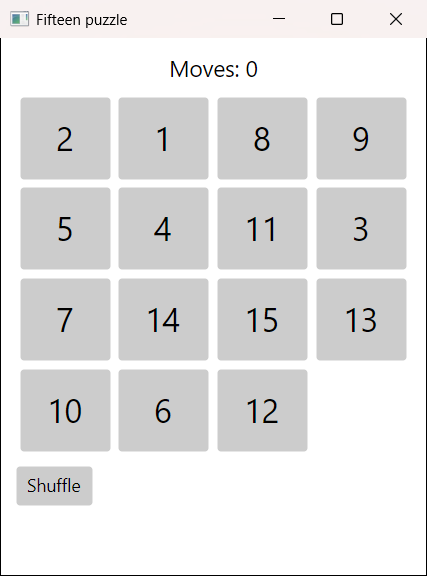
Fifteen Puzzle
Fifteen puzzle: slide the tiles into the empty cell to put the numbers in order
cd samples/UsingDotNet/tests/packages/AvaloniaSamples/apps/FifteenPuzzle then ring FifteenPuzzle.ringSource code
# Fifteen puzzle: slide the tiles into the empty cell to put the numbers in order

load "../../avalonia.ring"
avUse()

aBoard = list(16)          # 0 is the empty cell
aButtons = []
nMoves = 0

oWindow = avWindow("Fifteen puzzle",340,430)
oPanel = avStack(8,12)
oWindow.Content = oPanel
oInfo = avText("")
oInfo.FontSize = 18
oInfo.HorizontalAlignment = "Center"
oGrid = new UniformGrid()
oGrid.Columns = 4
oGrid.Rows = 4
oGrid.Height = 290
for nCell = 1 to 16
	oButton = avButton("","slide(" + nCell + ")")
	oButton {
		HorizontalAlignment = "Stretch"
		VerticalAlignment = "Stretch"
		HorizontalContentAlignment = "Center"
		VerticalContentAlignment = "Center"
		FontSize = 26
		Margin = avThickness(3)
	}
	aButtons + oButton
	oGrid.Children.Add(oButton)
next
oPanel {
	Children.Add(oInfo)
	Children.Add(oGrid)
	Children.Add(avButton("Shuffle","shuffle()"))
}
solved()
shuffle()

avRun(oWindow)

# --------------------------------------------------------------------------

# the tiles in order
func solved

	for nCell = 1 to 15
		aBoard[nCell] = nCell
	next
	aBoard[16] = 0
	nMoves = 0
	showAll()

func emptyCell

	return find(aBoard,0)

# the cells that touch a cell (the same row or the same column, one step away)
func isNear nCell, nOther

	nColumn = (nCell - 1) % 4
	nRow = floor((nCell - 1) / 4)
	nOtherColumn = (nOther - 1) % 4
	nOtherRow = floor((nOther - 1) / 4)
	return fabs(nColumn - nOtherColumn) + fabs(nRow - nOtherRow) = 1

# a tile slides into the empty cell when it touches it
func slide nCell

	nEmpty = emptyCell()
	if isNear(nCell,nEmpty)
		aBoard[nEmpty] = aBoard[nCell]
		aBoard[nCell] = 0
		nMoves++
		showAll()
	ok

# the board is shuffled by 200 legal slides, so that it can always be solved
func shuffle

	solved()
	for nTime = 1 to 200
		nEmpty = emptyCell()
		aNear = []
		for nCell = 1 to 16
			if isNear(nCell,nEmpty)
				aNear + nCell
			ok
		next
		nChosen = aNear[random(len(aNear) - 1) + 1]
		aBoard[nEmpty] = aBoard[nChosen]
		aBoard[nChosen] = 0
	next
	nMoves = 0
	showAll()

func isSolved

	for nCell = 1 to 15
		if aBoard[nCell] != nCell
			return False
		ok
	next
	return True

func showAll

	for nCell = 1 to 16
		if aBoard[nCell] = 0
			aButtons[nCell].Content = ""
			aButtons[nCell].IsVisible = False
		else
			aButtons[nCell].Content = "" + aBoard[nCell]
			aButtons[nCell].IsVisible = True
		ok
	next
	if isSolved()
		oInfo.Text = "Solved in " + nMoves + " moves!"
	else
		oInfo.Text = "Moves: " + nMoves
	ok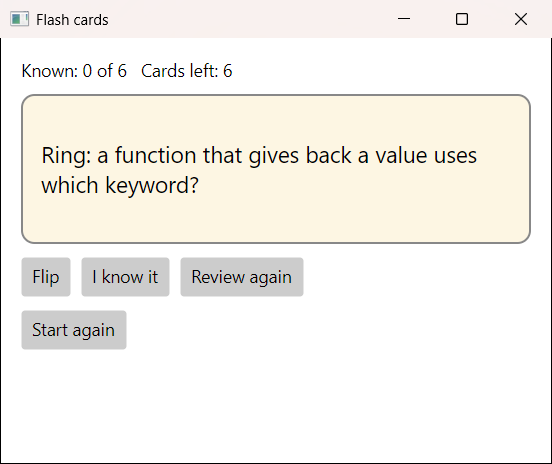
Flash Cards
Flash cards: a question on a card; Flip shows the answer; mark the card as known or to review; the known cards leave the pile
cd samples/UsingDotNet/tests/packages/AvaloniaSamples/apps/FlashCards then ring FlashCards.ringSource code
# Flash cards: a question on a card; Flip shows the answer; mark the card as known or to review; the known cards leave the pile

load "../../avalonia.ring"
avUse()

# [question, answer]
aCards = [
	["Ring: a function that gives back a value uses which keyword?","return"],
	["Ring: how do you start a comment?","With the # sign"],
	["Ring: which keyword ends an if block?","ok"],
	["Ring: the first item of a list has which index?","1"],
	["Ring: how do you create an object of a class?","new ClassName"],
	["Ring: which function gives the length of a list?","len()"]
]
aPile = []          # the numbers of the cards that are not known yet
nCurrent = 0
lShowingAnswer = False
nKnown = 0

oWindow = avWindow("Flash cards",440,340)
oPanel = avStack(10,16)
oWindow.Content = oPanel
oStatus = avText("")
oCard = new Border()
oCard {
	Height = 120
	Background = avBrush("#FDF6E3")
	BorderBrush = avBrush("#888888")
	BorderThickness = avThickness(2)
	CornerRadius = (new CornerRadius).Parse("10")
	Padding = avThickness(14)
}
oText = avText("")
oText.FontSize = 18
oText.TextWrapping = "Wrap"
oText.VerticalAlignment = "Center"
oCard.Child = oText
oFlip = avButton("Flip","flip()")
oKnown = avButton("I know it","known()")
oReview = avButton("Review again","review()")
oRow = avRow(8)
oRow {
	Children.Add(oFlip)
	Children.Add(oKnown)
	Children.Add(oReview)
}
oPanel {
	Children.Add(oStatus)
	Children.Add(oCard)
	Children.Add(oRow)
	Children.Add(avButton("Start again","restart()"))
}
restart()

avRun(oWindow)

# --------------------------------------------------------------------------

func restart

	aPile = []
	for nCard = 1 to len(aCards)
		aPile + nCard
	next
	nKnown = 0
	nextCard()

# the next card of the pile (the first one)
func nextCard

	lShowingAnswer = False
	if len(aPile) = 0
		oText.Text = "All cards are known!"
		oStatus.Text = "Known: " + nKnown + " of " + len(aCards)
		oFlip.IsEnabled = False
		oKnown.IsEnabled = False
		oReview.IsEnabled = False
		return
	ok
	nCurrent = aPile[1]
	oText.Text = aCards[nCurrent][1]
	oStatus.Text = "Known: " + nKnown + " of " + len(aCards) + "   Cards left: " + len(aPile)
	oFlip.IsEnabled = True
	oKnown.IsEnabled = True
	oReview.IsEnabled = True

func flip

	lShowingAnswer = not lShowingAnswer
	if lShowingAnswer
		oText.Text = aCards[nCurrent][2]
		oCard.Background = avBrush("#E8F1F2")
	else
		oText.Text = aCards[nCurrent][1]
		oCard.Background = avBrush("#FDF6E3")
	ok

func known

	del(aPile,1)
	nKnown++
	oCard.Background = avBrush("#FDF6E3")
	nextCard()

# the card goes to the end of the pile
func review

	nCard = aPile[1]
	del(aPile,1)
	aPile + nCard
	oCard.Background = avBrush("#FDF6E3")
	nextCard()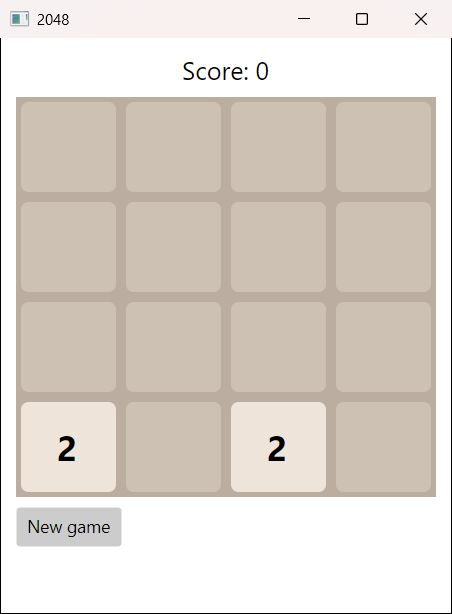
Game2048
2048: the arrow keys (or W A S D) slide the tiles; two equal tiles that meet join into one; reach 2048
cd samples/UsingDotNet/tests/packages/AvaloniaSamples/apps/Game2048 then ring Game2048.ringSource code
# 2048: the arrow keys (or W A S D) slide the tiles; two equal tiles that meet join into one; reach 2048

load "../../avalonia.ring"
avUse()

aBoard = list(16)          # 0 is an empty cell
aTiles = []
nScore = 0
lSpawn = True          # a new tile appears after a move (the checks turn this off)
aColors = ["#CDC1B4","#EEE4DA","#EDE0C8","#F2B179","#F59563","#F67C5F","#F65E3B","#EDCF72","#EDCC61","#EDC850","#EDC53F","#EDC22E"]

oWindow = avWindow("2048",360,460)
oPanel = avStack(8,12)
oWindow.Content = oPanel
oInfo = avText("")
oInfo.FontSize = 20
oInfo.HorizontalAlignment = "Center"
oGrid = new UniformGrid()
oGrid.Columns = 4
oGrid.Rows = 4
oGrid.Height = 320
oGrid.Background = avBrush("#BBADA0")
for nCell = 1 to 16
	oTile = new Border()
	oTile.Margin = avThickness(4)
	oTile.CornerRadius = (new CornerRadius).Parse("6")
	oLabel = avText("")
	oLabel.FontSize = 28
	oLabel.FontWeight = "Bold"
	oLabel.HorizontalAlignment = "Center"
	oLabel.VerticalAlignment = "Center"
	oTile.Child = oLabel
	aTiles + oTile
	oGrid.Children.Add(oTile)
next
oPanel {
	Children.Add(oInfo)
	Children.Add(oGrid)
	Children.Add(avButton("New game","newGame()"))
}
oWindow.setKeyDownEvent("keyDown(aDotNetArgs[2].Key)")
newGame()

avRun(oWindow)

# --------------------------------------------------------------------------

func newGame

	for nCell = 1 to 16
		aBoard[nCell] = 0
	next
	nScore = 0
	addTile()
	addTile()
	showAll()

# a 2 (or a 4 now and then) in an empty cell
func addTile

	if not lSpawn
		return
	ok
	aEmpty = []
	for nCell = 1 to 16
		if aBoard[nCell] = 0
			aEmpty + nCell
		ok
	next
	if len(aEmpty) = 0
		return
	ok
	nValue = 2
	if random(9) = 0
		nValue = 4
	ok
	aBoard[aEmpty[random(len(aEmpty) - 1) + 1]] = nValue

# a line of four cells slides to the left: [values, the points that the joins gave]
func slideLine aLine

	aValues = []
	for nValue in aLine
		if nValue > 0
			aValues + nValue
		ok
	next
	aResult = []
	nPoints = 0
	nPosition = 1
	while nPosition <= len(aValues)
		if nPosition < len(aValues) and aValues[nPosition] = aValues[nPosition + 1]
			aResult + (aValues[nPosition] * 2)
			nPoints += aValues[nPosition] * 2
			nPosition += 2
		else
			aResult + aValues[nPosition]
			nPosition++
		ok
	end
	while len(aResult) < 4
		aResult + 0
	end
	return [aResult,nPoints]

# a move in a direction: left, right, up or down; true when something moved
func move cDirection

	lMoved = False
	for nLine = 1 to 4
		aLine = lineCells(nLine,cDirection)
		aValues = []
		for nCell in aLine
			aValues + aBoard[nCell]
		next
		aSlid = slideLine(aValues)
		nIndex = 0
		for nCell in aLine
			nIndex++
			if aBoard[nCell] != aSlid[1][nIndex]
				lMoved = True
			ok
			aBoard[nCell] = aSlid[1][nIndex]
		next
		nScore += aSlid[2]
	next
	if lMoved
		addTile()
	ok
	showAll()
	return lMoved

# the four cells of a line in the order that they slide (the first cell is where the tiles go)
func lineCells nLine, cDirection

	aCells = []
	for nStep = 0 to 3
		switch cDirection
		on "Left"
			aCells + ((nLine - 1) * 4 + nStep + 1)
		on "Right"
			aCells + ((nLine - 1) * 4 + 4 - nStep)
		on "Up"
			aCells + (nStep * 4 + nLine)
		on "Down"
			aCells + ((3 - nStep) * 4 + nLine)
		off
	next
	return aCells

func keyDown cKey

	cKey = "" + cKey
	# the arrow keys, or W A S D
	aNames = [["Left","A"],["Right","D"],["Up","W"],["Down","S"]]
	for aName in aNames
		if cKey = aName[1] or cKey = aName[2]
			move(aName[1])
		ok
	next

func highest

	nHighest = 0
	for nValue in aBoard
		nHighest = max(nHighest,nValue)
	next
	return nHighest

func canMove

	for nCell = 1 to 16
		if aBoard[nCell] = 0
			return True
		ok
		if nCell % 4 != 0 and aBoard[nCell] = aBoard[nCell + 1]
			return True
		ok
		if nCell <= 12 and aBoard[nCell] = aBoard[nCell + 4]
			return True
		ok
	next
	return False

func showAll

	for nCell = 1 to 16
		nValue = aBoard[nCell]
		nColor = 1
		if nValue > 0
			nColor = min(12,floor(log(nValue) / log(2)) + 1)
		ok
		aTiles[nCell].Background = avBrush(aColors[nColor])
		if nValue > 0
			aTiles[nCell].Child.Text = "" + nValue
		else
			aTiles[nCell].Child.Text = ""
		ok
	next
	if highest() >= 2048
		oInfo.Text = "2048! Score: " + nScore
	but not canMove()
		oInfo.Text = "Game over. Score: " + nScore
	else
		oInfo.Text = "Score: " + nScore
	ok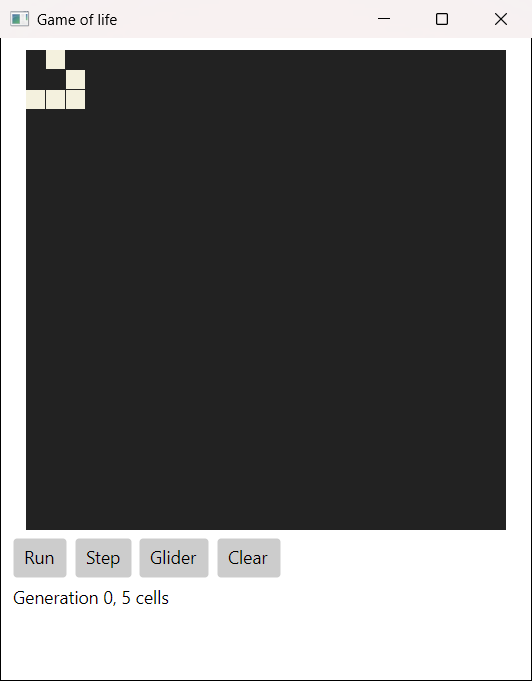
Game Of Life
The game of life: cells live or die by the number of living neighbors; click a cell to change it, press Run to watch the generations
cd samples/UsingDotNet/tests/packages/AvaloniaSamples/apps/GameOfLife then ring GameOfLife.ringSource code
# The game of life: cells live or die by the number of living neighbors; click a cell to change it, press Run to watch the generations

load "../../avalonia.ring"
avUse()

nSize = 24
nCell = 16
aCells = list(nSize * nSize)          # 1 = alive
aShapes = []
nGeneration = 0

oWindow = avWindow("Game of life",nSize * nCell + 40,nSize * nCell + 130)
oPanel = avStack(6,10)
oWindow.Content = oPanel
oCanvas = new Canvas()
oCanvas {
	Width = nSize * nCell
	Height = nSize * nCell
	Background = avBrush("#222222")
	setPointerPressedEvent("pressed(aDotNetArgs[2].GetPosition(oCanvas))")
}
for nIndex = 1 to nSize * nSize
	aCells[nIndex] = 0
	oShape = new Rectangle()
	oShape.Width = nCell - 1
	oShape.Height = nCell - 1
	oShape.Fill = avBrush("#222222")
	oCanvas.SetLeft(oShape,((nIndex - 1) % nSize) * nCell)
	oCanvas.SetTop(oShape,floor((nIndex - 1) / nSize) * nCell)
	oCanvas.Children.Add(oShape)
	aShapes + oShape
next
oInfo = avText("Generation 0, 0 cells")
oRun = avButton("Run","toggleRun()")
oBar = avRow(6)
oBar {
	Children.Add(oRun)
	Children.Add(avButton("Step","nextGeneration()"))
	Children.Add(avButton("Glider","glider()"))
	Children.Add(avButton("Clear","clear()"))
}
oPanel {
	Children.Add(oCanvas)
	Children.Add(oBar)
	Children.Add(oInfo)
}
oTimer = new DispatcherTimer()
oTimer.Interval = dnStatic("System.TimeSpan","FromMilliseconds",[150])
oTimer.setTickEvent("nextGeneration()")
glider()

avRun(oWindow)

# --------------------------------------------------------------------------

# the position of a click is a cell
func pressed oPosition

	nColumn = floor(oPosition.X / nCell)
	nRow = floor(oPosition.Y / nCell)
	if nColumn >= 0 and nColumn < nSize and nRow >= 0 and nRow < nSize
		toggle(nRow * nSize + nColumn + 1)
	ok

func toggle nIndex

	aCells[nIndex] = 1 - aCells[nIndex]
	paint(nIndex)
	count()

# a cell is drawn white when it is alive
func paint nIndex

	if aCells[nIndex] = 1
		aShapes[nIndex].Fill = avBrush("#F4F1DE")
	else
		aShapes[nIndex].Fill = avBrush("#222222")
	ok

func count

	nAlive = 0
	for nValue in aCells
		nAlive += nValue
	next
	oInfo.Text = "Generation " + nGeneration + ", " + nAlive + " cells"
	return nAlive

# the living neighbors of a cell (the world has no edge: the left side is next to the right side)
func neighbors nIndex

	nColumn = (nIndex - 1) % nSize
	nRow = floor((nIndex - 1) / nSize)
	nTotal = 0
	for nDy = -1 to 1
		for nDx = -1 to 1
			if not (nDx = 0 and nDy = 0)
				nOtherColumn = (nColumn + nDx + nSize) % nSize
				nOtherRow = (nRow + nDy + nSize) % nSize
				nTotal += aCells[nOtherRow * nSize + nOtherColumn + 1]
			ok
		next
	next
	return nTotal

# the next generation
func nextGeneration

	aNext = list(nSize * nSize)
	for nIndex = 1 to nSize * nSize
		nNear = neighbors(nIndex)
		if aCells[nIndex] = 1
			aNext[nIndex] = (nNear = 2 or nNear = 3)
		else
			aNext[nIndex] = (nNear = 3)
		ok
	next
	for nIndex = 1 to nSize * nSize
		if aNext[nIndex] != aCells[nIndex]
			aCells[nIndex] = aNext[nIndex]
			paint(nIndex)
		ok
	next
	nGeneration++
	count()

func clear

	for nIndex = 1 to nSize * nSize
		if aCells[nIndex] = 1
			aCells[nIndex] = 0
			paint(nIndex)
		ok
	next
	nGeneration = 0
	count()

func glider

	clear()
	for aPoint in [[2,1],[3,2],[1,3],[2,3],[3,3]]
		toggle((aPoint[2] - 1) * nSize + aPoint[1])
	next

func toggleRun

	if oTimer.IsEnabled
		oTimer.Stop()
		oRun.Content = "Run"
	else
		oTimer.Start()
		oRun.Content = "Stop"
	ok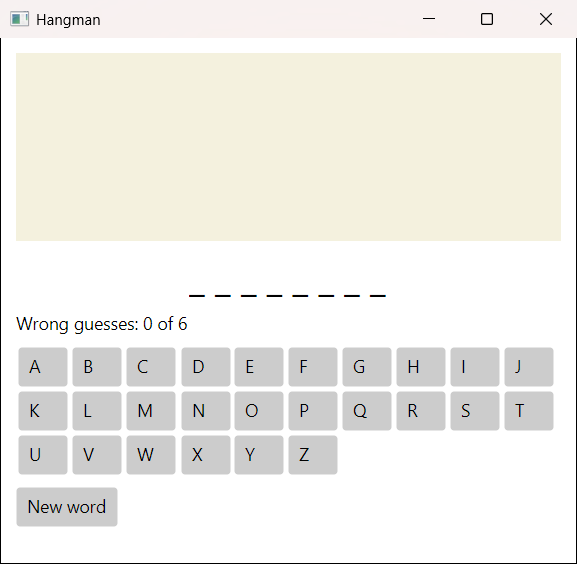
Hangman
Hangman: guess the word letter by letter; each wrong letter adds a part to the drawing
cd samples/UsingDotNet/tests/packages/AvaloniaSamples/apps/Hangman then ring Hangman.ringSource code
# Hangman: guess the word letter by letter; each wrong letter adds a part to the drawing

load "../../avalonia.ring"
avUse()

aWords = ["RING","AVALONIA","PROGRAM","WINDOW","BUTTON","KEYBOARD","FUNCTION","DOTNET"]
cWord = ""
cGuessed = ""
nWrong = 0
nMaxWrong = 6

oWindow = avWindow("Hangman",460,420)
oPanel = avStack(8,12)
oWindow.Content = oPanel
oCanvas = new Canvas()
oCanvas.Height = 150
oCanvas.Background = avBrush("#F4F1DE")
aParts = []
addPart(new Ellipse(),"head",110,20,40,40)
addPart(new Rectangle(),"body",127,60,6,50)
addPart(new Rectangle(),"left arm",100,70,30,5)
addPart(new Rectangle(),"right arm",130,70,30,5)
addPart(new Rectangle(),"left leg",110,110,5,35)
addPart(new Rectangle(),"right leg",145,110,5,35)
oWordText = avText("")
oWordText.FontSize = 30
oWordText.HorizontalAlignment = "Center"
oStatus = avText("")
oLetters = new WrapPanel()
aLetters = []
for nLetter = 65 to 90
	cLetter = char(nLetter)
	oKey = avButton(cLetter,"guess('" + cLetter + "')")
	oKey.Width = 40
	oKey.Margin = avThickness(2)
	oLetters.Children.Add(oKey)
	aLetters + oKey
next
oPanel {
	Children.Add(oCanvas)
	Children.Add(oWordText)
	Children.Add(oStatus)
	Children.Add(oLetters)
	Children.Add(avButton("New word","newGame()"))
}
newGame()

avRun(oWindow)

# --------------------------------------------------------------------------

# a part of the drawing (a shape that shows when a wrong letter is guessed)
func addPart oShape, cName, nX, nY, nWidth, nHeight

	oShape.Width = nWidth
	oShape.Height = nHeight
	oShape.Fill = avBrush("#3D405B")
	oShape.IsVisible = False
	oCanvas.SetLeft(oShape,nX)
	oCanvas.SetTop(oShape,nY)
	oCanvas.Children.Add(oShape)
	aParts + oShape

func newGame

	cWord = aWords[random(len(aWords) - 1) + 1]
	startWord(cWord)

func startWord cNewWord

	cWord = cNewWord
	cGuessed = ""
	nWrong = 0
	for oPart in aParts
		oPart.IsVisible = False
	next
	for oKey in aLetters
		oKey.IsEnabled = True
	next
	show()

# the word with _ for the letters that are not guessed yet
func shown

	cText = ""
	for cChar in cWord
		if substr(cGuessed,cChar) > 0
			cText += cChar + " "
		else
			cText += "_ "
		ok
	next
	return trim(cText)

func guess cLetter

	if isOver() or substr(cGuessed,cLetter) > 0
		return
	ok
	cGuessed += cLetter
	aLetters[ascii(cLetter) - 64].IsEnabled = False
	if substr(cWord,cLetter) = 0
		nWrong++
		aParts[nWrong].IsVisible = True
	ok
	show()

func isWon

	return substr(shown(),"_") = 0

func isOver

	return nWrong >= nMaxWrong or isWon()

func show

	oWordText.Text = shown()
	if isWon()
		oStatus.Text = "You won!"
	but nWrong >= nMaxWrong
		oStatus.Text = "You lost: the word was " + cWord
	else
		oStatus.Text = "Wrong guesses: " + nWrong + " of " + nMaxWrong
	ok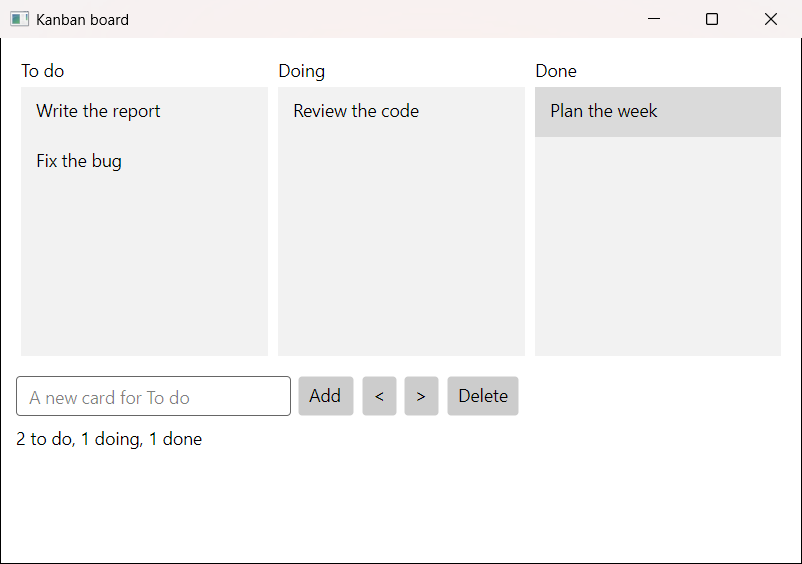
Kanban Board
A kanban board: three columns (To do, Doing, Done) with cards; add a card, move the selected card to the next or the previous column
cd samples/UsingDotNet/tests/packages/AvaloniaSamples/apps/KanbanBoard then ring KanbanBoard.ringSource code
# A kanban board: three columns (To do, Doing, Done) with cards; add a card, move the selected card to the next or the previous column

load "../../avalonia.ring"
avUse()

aNames = ["To do","Doing","Done"]
aColumns = [["Write the report","Fix the bug"],["Review the code"],["Plan the week"]]
aLists = []
nActive = 0          # the column of the selected card

oWindow = avWindow("Kanban board",640,420)
oPanel = avStack(8,12)
oWindow.Content = oPanel
oGrid = new Grid()
oGrid.ColumnDefinitions = (new ColumnDefinitions).Parse("*,*,*")
oGrid.Height = 250
for nColumn = 1 to 3
	oColumn = avStack(4,4)
	oColumn.Children.Add(avText(aNames[nColumn]))
	oList = new ListBox()
	oList.Height = 215
	oList.setSelectionChangedEvent("selected(" + nColumn + ")")
	oColumn.Children.Add(oList)
	oGrid.SetColumn(oColumn,nColumn - 1)
	oGrid.Children.Add(oColumn)
	aLists + oList
next
oNew = new TextBox()
oNew.Watermark = "A new card for To do"
oNew.Width = 220
oRow = avRow(6)
oRow {
	Children.Add(oNew)
	Children.Add(avButton("Add","addCard()"))
	Children.Add(avButton("<","moveCard(-1)"))
	Children.Add(avButton(">","moveCard(1)"))
	Children.Add(avButton("Delete","deleteCard()"))
}
oInfo = avText("")
oPanel {
	Children.Add(oGrid)
	Children.Add(oRow)
	Children.Add(oInfo)
}
showAll()

avRun(oWindow)

# --------------------------------------------------------------------------

func showAll

	for nColumn = 1 to 3
		aLists[nColumn].Items.Clear()
		for cCard in aColumns[nColumn]
			aLists[nColumn].Items.Add(cCard)
		next
	next
	oInfo.Text = "" + len(aColumns[1]) + " to do, " + len(aColumns[2]) + " doing, " + len(aColumns[3]) + " done"

# a card was selected: the other columns have no selection
func selected nColumn

	if aLists[nColumn].SelectedIndex < 0
		return
	ok
	nActive = nColumn
	for nOther = 1 to 3
		if nOther != nColumn and aLists[nOther].SelectedIndex >= 0
			aLists[nOther].UnselectAll()
		ok
	next

func addCard

	cText = oNew.Text
	if isstring(cText) and trim(cText) != ""
		aColumns[1] + trim(cText)
		oNew.Text = ""
		showAll()
	ok

# the selected card moves to the next column (1) or the previous one (-1)
func moveCard nStep

	if nActive = 0
		return
	ok
	nCard = aLists[nActive].SelectedIndex + 1
	nTarget = nActive + nStep
	if nCard < 1 or nTarget < 1 or nTarget > 3
		return
	ok
	cCard = aColumns[nActive][nCard]
	del(aColumns[nActive],nCard)
	aColumns[nTarget] + cCard
	nActive = 0
	showAll()

func deleteCard

	if nActive = 0
		return
	ok
	nCard = aLists[nActive].SelectedIndex + 1
	if nCard >= 1
		del(aColumns[nActive],nCard)
		nActive = 0
		showAll()
	ok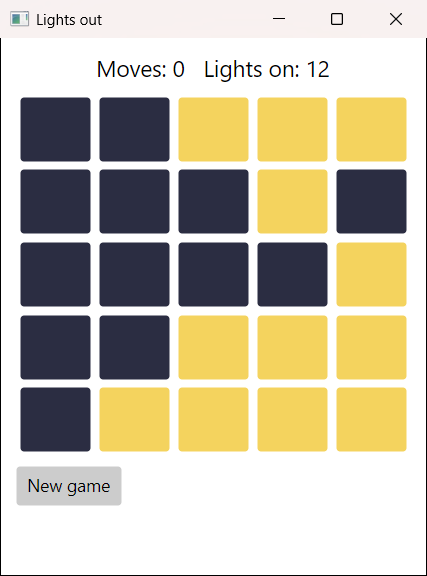
Lights Out
Lights out: a press toggles the cell and its four neighbors; turn all the lights off
cd samples/UsingDotNet/tests/packages/AvaloniaSamples/apps/LightsOut then ring LightsOut.ringSource code
# Lights out: a press toggles the cell and its four neighbors; turn all the lights off

load "../../avalonia.ring"
avUse()

nSize = 5
aLights = list(nSize * nSize)          # 1 = on
aButtons = []
nMoves = 0

oWindow = avWindow("Lights out",340,430)
oPanel = avStack(8,12)
oWindow.Content = oPanel
oInfo = avText("")
oInfo.FontSize = 18
oInfo.HorizontalAlignment = "Center"
oGrid = new UniformGrid()
oGrid.Columns = nSize
oGrid.Rows = nSize
oGrid.Height = 290
for nCell = 1 to nSize * nSize
	oButton = avButton("","press(" + nCell + ")")
	oButton {
		HorizontalAlignment = "Stretch"
		VerticalAlignment = "Stretch"
		Margin = avThickness(3)
	}
	aButtons + oButton
	oGrid.Children.Add(oButton)
next
oPanel {
	Children.Add(oInfo)
	Children.Add(oGrid)
	Children.Add(avButton("New game","newGame()"))
}
newGame()

avRun(oWindow)

# --------------------------------------------------------------------------

# a game is made by pressing cells at random from the solved board, so it can always be solved
func newGame

	for nCell = 1 to nSize * nSize
		aLights[nCell] = 0
	next
	nMoves = 0
	while lightsOn() < 5
		toggleAround(random(nSize * nSize - 1) + 1)
		toggleAround(random(nSize * nSize - 1) + 1)
		toggleAround(random(nSize * nSize - 1) + 1)
	end
	showAll()

# a cell and its neighbors change
func toggleAround nCell

	nColumn = (nCell - 1) % nSize
	nRow = floor((nCell - 1) / nSize)
	for aOffset in [[0,0],[1,0],[-1,0],[0,1],[0,-1]]
		nC = nColumn + aOffset[1]
		nR = nRow + aOffset[2]
		if nC >= 0 and nC < nSize and nR >= 0 and nR < nSize
			nIndex = nR * nSize + nC + 1
			aLights[nIndex] = 1 - aLights[nIndex]
		ok
	next

func lightsOn

	nOn = 0
	for nValue in aLights
		nOn += nValue
	next
	return nOn

func press nCell

	if lightsOn() = 0
		return
	ok
	toggleAround(nCell)
	nMoves++
	showAll()

func showAll

	for nCell = 1 to nSize * nSize
		if aLights[nCell] = 1
			aButtons[nCell].Background = avBrush("#F4D35E")
		else
			aButtons[nCell].Background = avBrush("#2B2D42")
		ok
	next
	if lightsOn() = 0
		oInfo.Text = "Solved in " + nMoves + " moves!"
	else
		oInfo.Text = "Moves: " + nMoves + "   Lights on: " + lightsOn()
	ok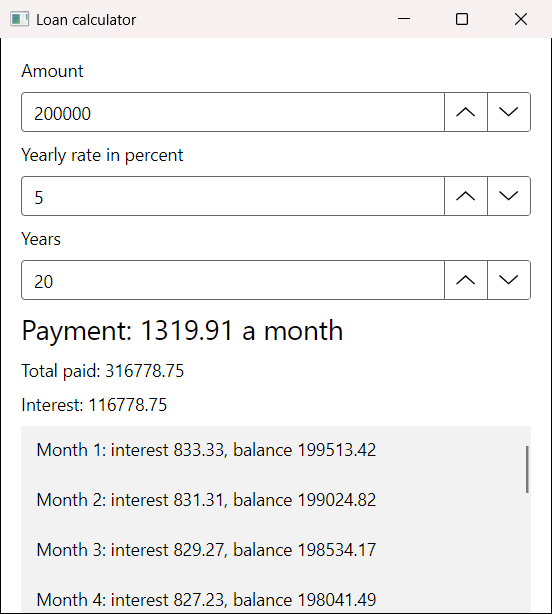
Loan Calculator
Loan calculator: the amount, the yearly rate and the years give the monthly payment, the total and the interest; a table of the first months
cd samples/UsingDotNet/tests/packages/AvaloniaSamples/apps/LoanCalculator then ring LoanCalculator.ringSource code
# Loan calculator: the amount, the yearly rate and the years give the monthly payment, the total and the interest; a table of the first months

load "../../avalonia.ring"
avUse()

oWindow = avWindow("Loan calculator",440,460)
oPanel = avStack(8,16)
oWindow.Content = oPanel
oAmount = box(200000,1000,10000000,1000)
oRate = box(5,0,30,0.25)
oYears = box(20,1,40,1)
oPayment = avText("")
oPayment.FontSize = 22
oTotal = avText("")
oInterest = avText("")
oTable = new ListBox()
oTable.Height = 150
oPanel {
	Children.Add(avText("Amount"))
	Children.Add(oAmount)
	Children.Add(avText("Yearly rate in percent"))
	Children.Add(oRate)
	Children.Add(avText("Years"))
	Children.Add(oYears)
	Children.Add(oPayment)
	Children.Add(oTotal)
	Children.Add(oInterest)
	Children.Add(oTable)
}
calculate()

avRun(oWindow)

# --------------------------------------------------------------------------

func box nValue, nMinimum, nMaximum, nStep

	oBox = new NumericUpDown()
	oBox {
		Minimum = nMinimum
		Maximum = nMaximum
		Increment = nStep
		Value = nValue
		setValueChangedEvent("calculate()")
	}
	return oBox

# a number with two decimals
func money nValue

	return "" + (floor(nValue * 100 + 0.5) / 100)

# the monthly payment of a loan with a fixed rate
func monthlyPayment nAmount, nYearlyRate, nYears

	nMonths = nYears * 12
	if nYearlyRate = 0
		return nAmount / nMonths
	ok
	nMonthly = nYearlyRate / 100 / 12
	return nAmount * nMonthly / (1 - pow(1 + nMonthly,-nMonths))

func calculate

	if not isobject(oTable)
		return
	ok
	nPayment = monthlyPayment(oAmount.Value,oRate.Value,oYears.Value)
	nMonths = oYears.Value * 12
	oPayment.Text = "Payment: " + money(nPayment) + " a month"
	oTotal.Text = "Total paid: " + money(nPayment * nMonths)
	oInterest.Text = "Interest: " + money(nPayment * nMonths - oAmount.Value)
	oTable.Items.Clear()
	nBalance = oAmount.Value
	nMonthly = oRate.Value / 100 / 12
	for nMonth = 1 to 12
		nInterestPart = nBalance * nMonthly
		nBalance = nBalance - (nPayment - nInterestPart)
		oTable.Items.Add("Month " + nMonth + ": interest " + money(nInterestPart) + ", balance " + money(nBalance))
	next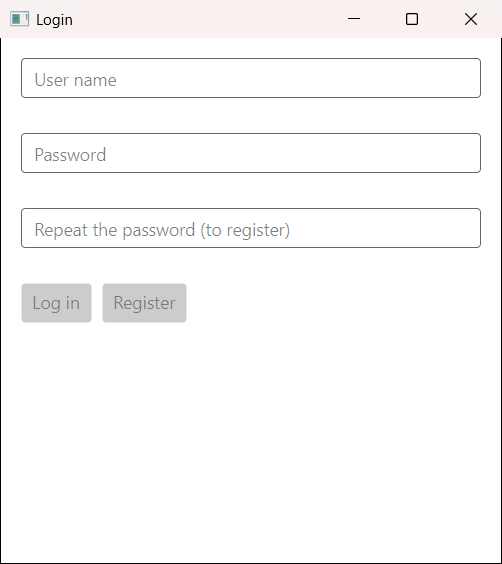
Login Form
A login and registration form with validation: the rules are checked as you type and the button is enabled only when all of them are met
cd samples/UsingDotNet/tests/packages/AvaloniaSamples/apps/LoginForm then ring LoginForm.ringSource code
# A login and registration form with validation: the rules are checked as you type and the button is enabled only when all of them are met

load "../../avalonia.ring"
avUse()

aUsers = [["admin","Secret123"]]          # [name, password]
lLoggedIn = False

oWindow = avWindow("Login",400,420)
oPanel = avStack(6,16)
oWindow.Content = oPanel
oName = new TextBox()
oName.Watermark = "User name"
oName.setTextChangedEvent("validate()")
oNameError = error()
oPassword = new TextBox()
oPassword.PasswordChar = "*"
oPassword.Watermark = "Password"
oPassword.setTextChangedEvent("validate()")
oPasswordError = error()
oRepeat = new TextBox()
oRepeat.PasswordChar = "*"
oRepeat.Watermark = "Repeat the password (to register)"
oRepeat.setTextChangedEvent("validate()")
oRepeatError = error()
oLogin = avButton("Log in","login()")
oRegister = avButton("Register","register()")
oMessage = avText("")
oMessage.FontSize = 16
oRow = avRow(8)
oRow {
	Children.Add(oLogin)
	Children.Add(oRegister)
}
oPanel {
	Children.Add(oName)
	Children.Add(oNameError)
	Children.Add(oPassword)
	Children.Add(oPasswordError)
	Children.Add(oRepeat)
	Children.Add(oRepeatError)
	Children.Add(oRow)
	Children.Add(oMessage)
}
validate()

avRun(oWindow)

# --------------------------------------------------------------------------

# a red text for the message of a rule that is not met
func error

	oText = avText("")
	oText.Foreground = avBrush("#C73E1D")
	oText.FontSize = 12
	return oText

func textOf oBox

	cText = oBox.Text
	if isstring(cText)
		return cText
	ok
	return ""

# the problem of a user name ("" when it is fine): at least 3 letters or digits
func nameProblem cName

	if len(cName) < 3
		return "The name needs at least 3 characters"
	ok
	for cChar in cName
		if not (isalpha(cChar) or isdigit(cChar) or cChar = "_")
			return "Use letters, digits and _ only"
		ok
	next
	return ""

# the problem of a password: 8 characters, a capital letter and a digit
func passwordProblem cPassword

	if len(cPassword) < 8
		return "The password needs at least 8 characters"
	ok
	if cPassword = lower(cPassword)
		return "The password needs a capital letter"
	ok
	lDigit = False
	for cChar in cPassword
		if isdigit(cChar)
			lDigit = True
		ok
	next
	if not lDigit
		return "The password needs a digit"
	ok
	return ""

func userIndex cName

	for nUser = 1 to len(aUsers)
		if aUsers[nUser][1] = cName
			return nUser
		ok
	next
	return 0

func validate

	if not isobject(oMessage)
		return
	ok
	cName = textOf(oName)
	cPassword = textOf(oPassword)
	cRepeat = textOf(oRepeat)
	oNameError.Text = ""
	oPasswordError.Text = ""
	oRepeatError.Text = ""
	if cName != ""
		oNameError.Text = nameProblem(cName)
	ok
	if cPassword != ""
		oPasswordError.Text = passwordProblem(cPassword)
	ok
	if cRepeat != "" and cRepeat != cPassword
		oRepeatError.Text = "The passwords are not the same"
	ok
	oLogin.IsEnabled = cName != "" and cPassword != ""
	oRegister.IsEnabled = nameProblem(cName) = "" and passwordProblem(cPassword) = "" and cRepeat = cPassword

func login

	nUser = userIndex(textOf(oName))
	if nUser > 0 and aUsers[nUser][2] = textOf(oPassword)
		lLoggedIn = True
		oMessage.Text = "Welcome, " + textOf(oName) + "!"
	else
		lLoggedIn = False
		oMessage.Text = "Wrong name or password"
	ok

func register

	if userIndex(textOf(oName)) > 0
		oMessage.Text = "That name is taken"
		return
	ok
	aUsers + [textOf(oName),textOf(oPassword)]
	oMessage.Text = "Registered " + textOf(oName) + ": " + len(aUsers) + " users"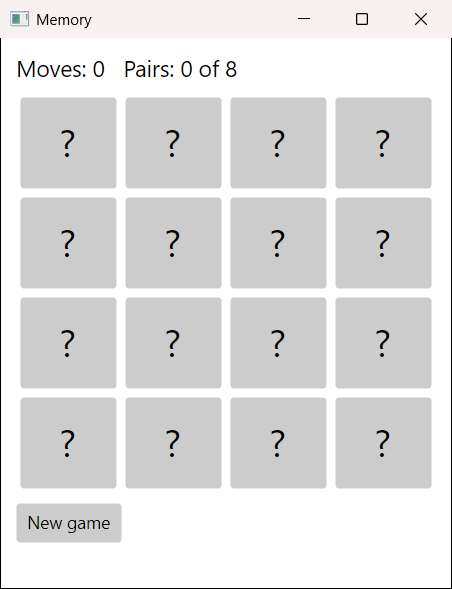
Memory Game
Memory game: eight pairs of cards face down; turn two at a time, a pair stays open; the moves are counted
cd samples/UsingDotNet/tests/packages/AvaloniaSamples/apps/MemoryGame then ring MemoryGame.ringSource code
# Memory game: eight pairs of cards face down; turn two at a time, a pair stays open; the moves are counted

load "../../avalonia.ring"
avUse()

aSymbols = ["A","B","C","D","E","F","G","H"]
aCards = []          # the symbol of each of the 16 cards
aOpen = []           # the cards that are turned now (at most two)
aFound = list(16)    # 1 when the card belongs to a pair that was found
nMoves = 0
nPairs = 0

oWindow = avWindow("Memory",360,440)
oPanel = avStack(8,12)
oWindow.Content = oPanel
oInfo = avText("")
oInfo.FontSize = 18
oGrid = new UniformGrid()
oGrid.Columns = 4
oGrid.Rows = 4
oGrid.Height = 320
aButtons = []
for nCard = 1 to 16
	oCard = avButton("?","flip(" + nCard + ")")
	oCard {
		HorizontalAlignment = "Stretch"
		VerticalAlignment = "Stretch"
		HorizontalContentAlignment = "Center"
		VerticalContentAlignment = "Center"
		FontSize = 30
		Margin = avThickness(3)
	}
	aButtons + oCard
	oGrid.Children.Add(oCard)
next
oPanel {
	Children.Add(oInfo)
	Children.Add(oGrid)
	Children.Add(avButton("New game","newGame()"))
}
newGame()

avRun(oWindow)

# --------------------------------------------------------------------------

func newGame

	aCards = []
	for cSymbol in aSymbols
		aCards + cSymbol
		aCards + cSymbol
	next
	shuffle()
	deal()

# the cards in a random order
func shuffle

	for nCard = 16 to 2 step -1
		nOther = random(nCard - 1) + 1
		cTemp = aCards[nCard]
		aCards[nCard] = aCards[nOther]
		aCards[nOther] = cTemp
	next

# the cards face down, the counters at zero
func deal

	aOpen = []
	nMoves = 0
	nPairs = 0
	for nCard = 1 to 16
		aFound[nCard] = 0
		aButtons[nCard].Content = "?"
		aButtons[nCard].IsEnabled = True
	next
	show()

# the player turns a card
func flip nCard

	if aFound[nCard] = 1 or find(aOpen,nCard) > 0
		return
	ok
	if len(aOpen) = 2
		closeCards()
	ok
	aButtons[nCard].Content = aCards[nCard]
	aOpen + nCard
	if len(aOpen) = 2
		nMoves++
		if aCards[aOpen[1]] = aCards[aOpen[2]]
			for nPair in aOpen
				aFound[nPair] = 1
				aButtons[nPair].IsEnabled = False
			next
			nPairs++
			aOpen = []
		ok
	ok
	show()

# the two cards that do not match are turned face down
func closeCards

	for nPair in aOpen
		aButtons[nPair].Content = "?"
	next
	aOpen = []

func show

	if nPairs = 8
		oInfo.Text = "You won in " + nMoves + " moves!"
	else
		oInfo.Text = "Moves: " + nMoves + "   Pairs: " + nPairs + " of 8"
	ok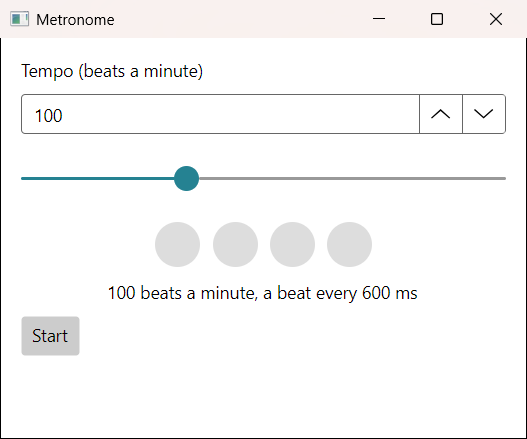
Metronome
Metronome: a tempo from 40 to 220 beats a minute, a light that moves with each beat and the beats of a bar (the first one is the accent)
cd samples/UsingDotNet/tests/packages/AvaloniaSamples/apps/Metronome then ring Metronome.ringSource code
# Metronome: a tempo from 40 to 220 beats a minute, a light that moves with each beat and the beats of a bar (the first one is the accent)

load "../../avalonia.ring"
avUse()

nTempo = 100
nBeat = 0
nBeatsInBar = 4

oWindow = avWindow("Metronome",420,320)
oPanel = avStack(10,16)
oWindow.Content = oPanel
oTempo = new NumericUpDown()
oTempo {
	Minimum = 40
	Maximum = 220
	Value = 100
	setValueChangedEvent("tempoChanged()")
}
oSlider = new Slider()
oSlider {
	Minimum = 40
	Maximum = 220
	Value = 100
	setValueChangedEvent("sliderMoved()")
}
oLights = avRow(10)
oLights.HorizontalAlignment = "Center"
aLights = []
for nLight = 1 to nBeatsInBar
	oLight = new Ellipse()
	oLight.Width = 36
	oLight.Height = 36
	oLights.Children.Add(oLight)
	aLights + oLight
next
oInfo = avText("")
oInfo.HorizontalAlignment = "Center"
oStart = avButton("Start","startStop()")
oPanel {
	Children.Add(avText("Tempo (beats a minute)"))
	Children.Add(oTempo)
	Children.Add(oSlider)
	Children.Add(oLights)
	Children.Add(oInfo)
	Children.Add(oStart)
}
oTimer = new DispatcherTimer()
oTimer.setTickEvent("beat()")
tempoChanged()
showLights()

avRun(oWindow)

# --------------------------------------------------------------------------

# the milliseconds between two beats
func interval nBeatsAMinute

	return floor(60000 / nBeatsAMinute)

func tempoChanged

	if not isobject(oInfo)
		return
	ok
	nTempo = floor(oTempo.Value)
	oSlider.Value = nTempo
	oTimer.Interval = dnStatic("System.TimeSpan","FromMilliseconds",[interval(nTempo)])
	oInfo.Text = "" + nTempo + " beats a minute, a beat every " + interval(nTempo) + " ms"

func sliderMoved

	if isobject(oTempo) and floor(oSlider.Value) != floor(oTempo.Value)
		oTempo.Value = floor(oSlider.Value)
	ok

func showLights

	for nLight = 1 to nBeatsInBar
		if nLight = nBeat and nBeat = 1
			aLights[nLight].Fill = avBrush("#E63946")
		but nLight = nBeat
			aLights[nLight].Fill = avBrush("#2A9D8F")
		else
			aLights[nLight].Fill = avBrush("#DDDDDD")
		ok
	next

func beat

	nBeat++
	if nBeat > nBeatsInBar
		nBeat = 1
	ok
	showLights()

func startStop

	if oTimer.IsEnabled
		oTimer.Stop()
		oStart.Content = "Start"
		nBeat = 0
		showLights()
	else
		oTimer.Start()
		oStart.Content = "Stop"
	ok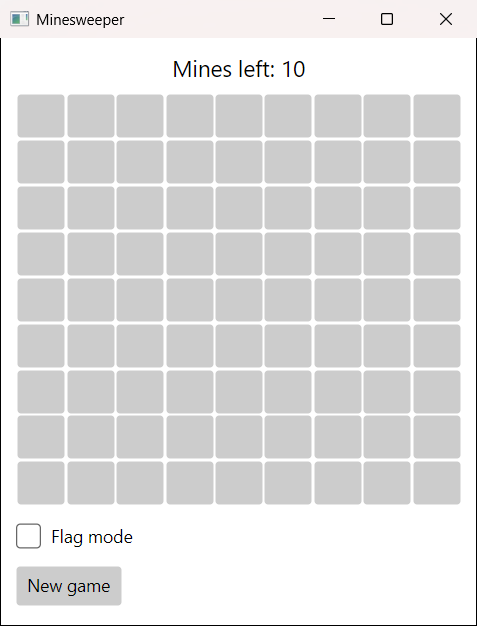
Minesweeper
Minesweeper: open the cells without a mine; a number tells how many mines touch the cell; the Flag check box marks the cells that you think have a mine
cd samples/UsingDotNet/tests/packages/AvaloniaSamples/apps/Minesweeper then ring Minesweeper.ringSource code
# Minesweeper: open the cells without a mine; a number tells how many mines touch the cell; the Flag check box marks the cells that you think have a mine

load "../../avalonia.ring"
avUse()

nColumns = 9
nRows = 9
nMines = 10
aMine = list(nColumns * nRows)          # 1 = a mine
aOpen = list(nColumns * nRows)          # 1 = opened
aFlag = list(nColumns * nRows)          # 1 = flagged
aButtons = []
lOver = False
lFirst = True          # the mines are placed at the first click, so the first cell is never a mine

oWindow = avWindow("Minesweeper",380,470)
oPanel = avStack(8,12)
oWindow.Content = oPanel
oInfo = avText("")
oInfo.FontSize = 18
oInfo.HorizontalAlignment = "Center"
oGrid = new UniformGrid()
oGrid.Columns = nColumns
oGrid.Rows = nRows
oGrid.Height = 330
for nCell = 1 to nColumns * nRows
	oButton = avButton("","click(" + nCell + ")")
	oButton {
		HorizontalAlignment = "Stretch"
		VerticalAlignment = "Stretch"
		HorizontalContentAlignment = "Center"
		VerticalContentAlignment = "Center"
		Padding = avThickness(0)
		Margin = avThickness(1)
		FontWeight = "Bold"
	}
	aButtons + oButton
	oGrid.Children.Add(oButton)
next
oFlag = new CheckBox()
oFlag.Content = "Flag mode"
oPanel {
	Children.Add(oInfo)
	Children.Add(oGrid)
	Children.Add(oFlag)
	Children.Add(avButton("New game","newGame()"))
}
newGame()

avRun(oWindow)

# --------------------------------------------------------------------------

func newGame

	for nCell = 1 to nColumns * nRows
		aMine[nCell] = 0
		aOpen[nCell] = 0
		aFlag[nCell] = 0
	next
	lOver = False
	lFirst = True
	showAll()

# the mines go to random cells that are not the first cell
func placeMines nAvoid

	nPlaced = 0
	while nPlaced < nMines
		nCell = random(nColumns * nRows - 1) + 1
		if aMine[nCell] = 0 and nCell != nAvoid
			aMine[nCell] = 1
			nPlaced++
		ok
	end

# the cells around a cell
func around nCell

	nColumn = (nCell - 1) % nColumns
	nRow = floor((nCell - 1) / nColumns)
	aNear = []
	for nDy = -1 to 1
		for nDx = -1 to 1
			if not (nDx = 0 and nDy = 0)
				nC = nColumn + nDx
				nR = nRow + nDy
				if nC >= 0 and nC < nColumns and nR >= 0 and nR < nRows
					aNear + (nR * nColumns + nC + 1)
				ok
			ok
		next
	next
	return aNear

# the number of mines around a cell
func minesAround nCell

	nCount = 0
	for nNear in around(nCell)
		nCount += aMine[nNear]
	next
	return nCount

func click nCell

	if lOver or aOpen[nCell] = 1
		return
	ok
	if oFlag.IsChecked
		aFlag[nCell] = 1 - aFlag[nCell]
		showAll()
		return
	ok
	if aFlag[nCell] = 1
		return
	ok
	if lFirst
		placeMines(nCell)
		lFirst = False
	ok
	openCell(nCell)
	if aMine[nCell] = 1
		lOver = True
	ok
	showAll()

# a cell opens; a cell with no mine around opens its neighbors too
func openCell nCell

	aStack = [nCell]
	while len(aStack) > 0
		nOne = aStack[len(aStack)]
		del(aStack,len(aStack))
		if aOpen[nOne] = 0 and aFlag[nOne] = 0
			aOpen[nOne] = 1
			if aMine[nOne] = 0 and minesAround(nOne) = 0
				for nNear in around(nOne)
					if aOpen[nNear] = 0
						aStack + nNear
					ok
				next
			ok
		ok
	end

func closedSafe

	nCount = 0
	for nCell = 1 to nColumns * nRows
		if aOpen[nCell] = 0 and aMine[nCell] = 0
			nCount++
		ok
	next
	return nCount

func isWon

	return not lFirst and not lOver and closedSafe() = 0

func showAll

	for nCell = 1 to nColumns * nRows
		oButton = aButtons[nCell]
		if aOpen[nCell] = 1
			oButton.IsEnabled = False
			if aMine[nCell] = 1
				oButton.Content = "*"
				oButton.Background = avBrush("#E63946")
			else
				nNear = minesAround(nCell)
				if nNear > 0
					oButton.Content = "" + nNear
				else
					oButton.Content = ""
				ok
			ok
		else
			oButton.IsEnabled = True
			if lOver and aMine[nCell] = 1
				oButton.Content = "*"
			but aFlag[nCell] = 1
				oButton.Content = "F"
			else
				oButton.Content = ""
			ok
		ok
	next
	nFlags = 0
	for nValue in aFlag
		nFlags += nValue
	next
	if lOver
		oInfo.Text = "Boom! Game over"
	but isWon()
		oInfo.Text = "You cleared the field!"
	else
		oInfo.Text = "Mines left: " + (nMines - nFlags)
	ok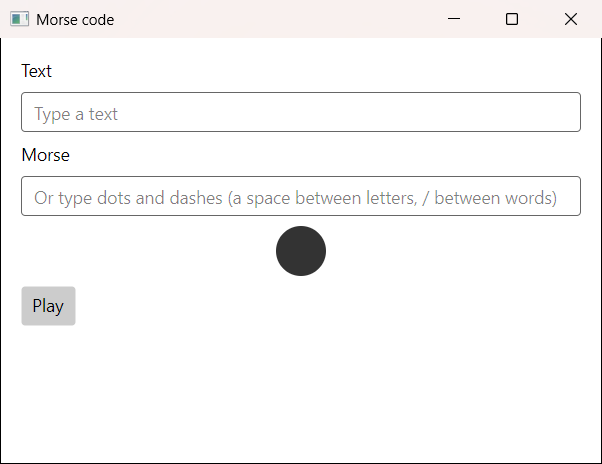
Morse Code
Morse code: a text becomes dots and dashes and back; the Play button shows the signal on a light that goes on and off with a timer
cd samples/UsingDotNet/tests/packages/AvaloniaSamples/apps/MorseCode then ring MorseCode.ringSource code
# Morse code: a text becomes dots and dashes and back; the Play button shows the signal on a light that goes on and off with a timer

load "../../avalonia.ring"
avUse()

aLetters = ["A",".-","B","-...","C","-.-.","D","-..","E",".","F","..-.","G","--.","H","....","I","..","J",".---","K","-.-","L",".-..","M","--",
	"N","-.","O","---","P",".--.","Q","--.-","R",".-.","S","...","T","-","U","..-","V","...-","W",".--","X","-..-","Y","-.--","Z","--..",
	"0","-----","1",".----","2","..---","3","...--","4","....-","5",".....","6","-....","7","--...","8","---..","9","----."]
aSignal = []          # the steps of the light: 1 on, 0 off, one for each unit of time
nStep = 0
lBusy = False

oWindow = avWindow("Morse code",480,340)
oPanel = avStack(8,16)
oWindow.Content = oPanel
oText = new TextBox()
oText.Watermark = "Type a text"
oText.setTextChangedEvent("textChanged()")
oMorse = new TextBox()
oMorse.Watermark = "Or type dots and dashes (a space between letters, / between words)"
oMorse.setTextChangedEvent("morseChanged()")
oLight = new Ellipse()
oLight.Width = 40
oLight.Height = 40
oLight.Fill = avBrush("#333333")
oLight.HorizontalAlignment = "Center"
oPanel {
	Children.Add(avText("Text"))
	Children.Add(oText)
	Children.Add(avText("Morse"))
	Children.Add(oMorse)
	Children.Add(oLight)
	Children.Add(avButton("Play","play()"))
}
oTimer = new DispatcherTimer()
oTimer.Interval = dnStatic("System.TimeSpan","FromMilliseconds",[100])
oTimer.setTickEvent("stepLight()")

avRun(oWindow)

# --------------------------------------------------------------------------

func codeOf cLetter

	nAt = find(aLetters,upper(cLetter))
	if nAt > 0 and nAt % 2 = 1
		return aLetters[nAt + 1]
	ok
	return ""

func letterOf cCode

	for nAt = 2 to len(aLetters) step 2
		if aLetters[nAt] = cCode
			return aLetters[nAt - 1]
		ok
	next
	return "?"

# a text as Morse code: letters apart by a space, words by /
func toMorse cText

	cResult = ""
	for cChar in cText
		if cChar = " "
			cResult += " / "
		else
			cCode = codeOf(cChar)
			if cCode != ""
				if cResult != "" and right(cResult,1) != " "
					cResult += " "
				ok
				cResult += cCode
			ok
		ok
	next
	return trim(cResult)

func fromMorse cMorse

	cResult = ""
	for cWord in str2list(substr(cMorse," / ",nl))
		if cResult != ""
			cResult += " "
		ok
		for cCode in str2list(substr(trim(cWord)," ",nl))
			if cCode != ""
				cResult += letterOf(cCode)
			ok
		next
	next
	return cResult

func textOf oBox

	cText = oBox.Text
	if isstring(cText)
		return cText
	ok
	return ""

func textChanged

	if not lBusy
		lBusy = True
		oMorse.Text = toMorse(textOf(oText))
		lBusy = False
	ok

func morseChanged

	if not lBusy
		lBusy = True
		oText.Text = fromMorse(textOf(oMorse))
		lBusy = False
	ok

# the light: a dot is one unit on, a dash three, one unit off between signs, three between letters, seven between words
func signalOf cMorse

	aSteps = []
	nSigns = len(cMorse)
	for nSign = 1 to nSigns
		cSign = cMorse[nSign]
		if cSign = "."
			aSteps + 1
			aSteps + 0
		but cSign = "-"
			aSteps + 1
			aSteps + 1
			aSteps + 1
			aSteps + 0
		but cSign = " " and cMorse[nSign + 1] != "/" and cMorse[nSign - 1] != "/"
			aSteps + 0
			aSteps + 0
		but cSign = "/"
			for nGap = 1 to 4
				aSteps + 0
			next
		ok
	next
	return aSteps

func play

	aSignal = signalOf(textOf(oMorse))
	nStep = 0
	if len(aSignal) > 0
		oTimer.Start()
	ok

func stepLight

	nStep++
	if nStep > len(aSignal)
		oTimer.Stop()
		oLight.Fill = avBrush("#333333")
		return
	ok
	if aSignal[nStep] = 1
		oLight.Fill = avBrush("#FFD93D")
	else
		oLight.Fill = avBrush("#333333")
	ok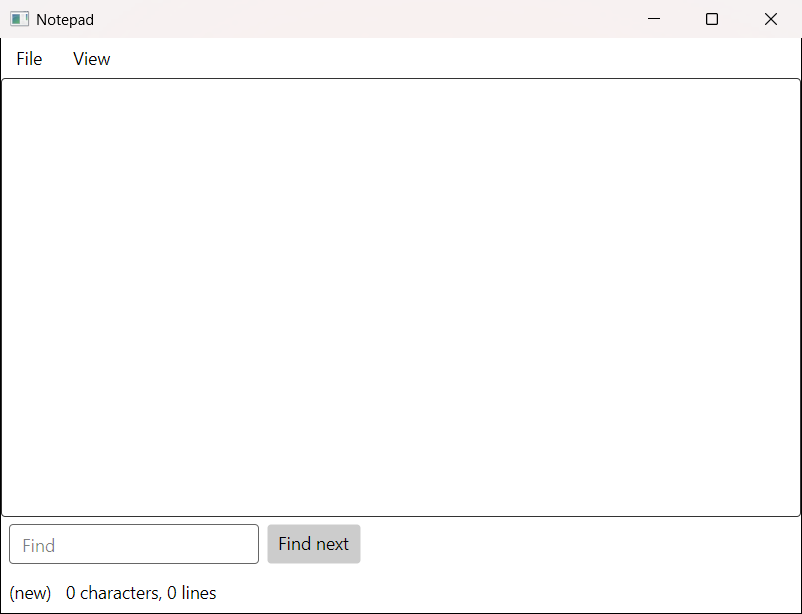
Notepad
Notepad: a text editor with a menu (new, open, save, quit; cut, find; word wrap), a status bar and a find box; files are read and written with Ring
cd samples/UsingDotNet/tests/packages/AvaloniaSamples/apps/Notepad then ring Notepad.ringSource code
# Notepad: a text editor with a menu (new, open, save, quit; cut, find; word wrap), a status bar and a find box; files are read and written with Ring

load "../../avalonia.ring"
avUse()

cFile = ""          # the file of the text ("" for a new text)
lChanged = False
nFindAt = 0

oWindow = avWindow("Notepad",640,460)
oDock = new DockPanel()
oWindow.Content = oDock
oMenu = new Menu()
oFileMenu = menu("File")
oNew = item("New","newText()")
oOpen = item("Open sample.txt","openFile()")
oSave = item("Save","saveFile()")
oWrap = item("Word wrap","toggleWrap()")
oFileMenu.Items.Add(oNew)
oFileMenu.Items.Add(oOpen)
oFileMenu.Items.Add(oSave)
oViewMenu = menu("View")
oViewMenu.Items.Add(oWrap)
oMenu.Items.Add(oFileMenu)
oMenu.Items.Add(oViewMenu)
oDock.SetDock(oMenu,"Top")
oStatus = avText("")
oStatus.Margin = avThickness(6)
oDock.SetDock(oStatus,"Bottom")
oFindRow = avRow(6)
oFindRow.Margin = avThickness(6)
oFind = new TextBox()
oFind.Width = 200
oFind.Watermark = "Find"
oFindRow {
	Children.Add(oFind)
	Children.Add(avButton("Find next","findNext()"))
}
oDock.SetDock(oFindRow,"Bottom")
oEditor = new TextBox()
oEditor {
	AcceptsReturn = True
	TextWrapping = "NoWrap"
	setTextChangedEvent("edited()")
}
oDock {
	Children.Add(oMenu)
	Children.Add(oStatus)
	Children.Add(oFindRow)
	Children.Add(oEditor)
}
updateStatus()

avRun(oWindow)

# --------------------------------------------------------------------------

func menu cHeader

	oItem = new MenuItem()
	oItem.Header = cHeader
	return oItem

func item cHeader, cCode

	oItem = new MenuItem()
	oItem.Header = cHeader
	oItem.setClickEvent(cCode)
	return oItem

func textOf

	cText = oEditor.Text
	if isstring(cText)
		return cText
	ok
	return ""

func edited

	lChanged = True
	updateStatus()

func updateStatus

	if not isobject(oStatus)
		return
	ok
	cText = textOf()
	nLines = 0
	if cText != ""
		nLines = len(str2list(cText))
	ok
	cName = cFile
	if cName = ""
		cName = "(new)"
	ok
	cMark = ""
	if lChanged
		cMark = " *"
	ok
	oStatus.Text = cName + cMark + "   " + len(cText) + " characters, " + nLines + " lines"

func newText

	oEditor.Text = ""
	cFile = ""
	lChanged = False
	updateStatus()

func openFile

	if fexists("sample.txt")
		oEditor.Text = read("sample.txt")
		cFile = "sample.txt"
		lChanged = False
	else
		oStatus.Text = "sample.txt was not found"
		return
	ok
	updateStatus()

func saveFile

	if cFile = ""
		cFile = "notes.txt"
	ok
	write(cFile,textOf())
	lChanged = False
	updateStatus()

func toggleWrap

	if oEditor.TextWrapping = "Wrap"
		oEditor.TextWrapping = "NoWrap"
	else
		oEditor.TextWrapping = "Wrap"
	ok

# the next place where the text of the find box is (from the position after the last one); the text is selected
func findNext

	cWhat = oFind.Text
	if not isstring(cWhat) or cWhat = ""
		return
	ok
	cText = lower(textOf())
	nAt = 0
	nSize = len(cText)
	nWant = len(cWhat)
	for nPos = nFindAt + 1 to nSize - nWant + 1
		if substr(cText,nPos,nWant) = lower(cWhat)
			nAt = nPos
			exit
		ok
	next
	if nAt = 0
		nFindAt = 0
		oStatus.Text = "Not found"
		return
	ok
	nFindAt = nAt
	oEditor.SelectionStart = nAt - 1
	oEditor.SelectionEnd = nAt - 1 + nWant
	oStatus.Text = "Found at " + nAt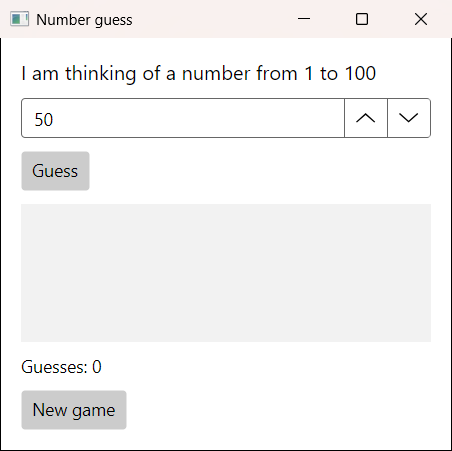
Number Guess
Number guess: the program thinks of a number from 1 to 100; every guess gets a hint and the guesses are counted
cd samples/UsingDotNet/tests/packages/AvaloniaSamples/apps/NumberGuess then ring NumberGuess.ringSource code
# Number guess: the program thinks of a number from 1 to 100; every guess gets a hint and the guesses are counted

load "../../avalonia.ring"
avUse()

nSecret = 0
nGuesses = 0
lWon = False

oWindow = avWindow("Number guess",360,330)
oPanel = avStack(10,16)
oWindow.Content = oPanel
oHint = avText("I am thinking of a number from 1 to 100")
oHint.TextWrapping = "Wrap"
oHint.FontSize = 16
oGuess = new NumericUpDown()
oGuess {
	Minimum = 1
	Maximum = 100
	Value = 50
}
oHistory = new ListBox()
oHistory.Height = 110
oCount = avText("Guesses: 0")
oPanel {
	Children.Add(oHint)
	Children.Add(oGuess)
	Children.Add(avButton("Guess","guess()"))
	Children.Add(oHistory)
	Children.Add(oCount)
	Children.Add(avButton("New game","newGame()"))
}
newGame()

avRun(oWindow)

# --------------------------------------------------------------------------

func newGame

	nSecret = random(99) + 1
	nGuesses = 0
	lWon = False
	oHistory.Items.Clear()
	oHint.Text = "I am thinking of a number from 1 to 100"
	oCount.Text = "Guesses: 0"

func guess

	if lWon
		return
	ok
	nValue = floor(oGuess.Value)
	nGuesses++
	if nValue < nSecret
		cHint = "too low"
	but nValue > nSecret
		cHint = "too high"
	else
		cHint = "correct!"
		lWon = True
	ok
	oHistory.Items.Add("" + nValue + " is " + cHint)
	oCount.Text = "Guesses: " + nGuesses
	if lWon
		oHint.Text = "You found " + nSecret + " in " + nGuesses + " guesses"
	else
		oHint.Text = "" + nValue + " is " + cHint
	ok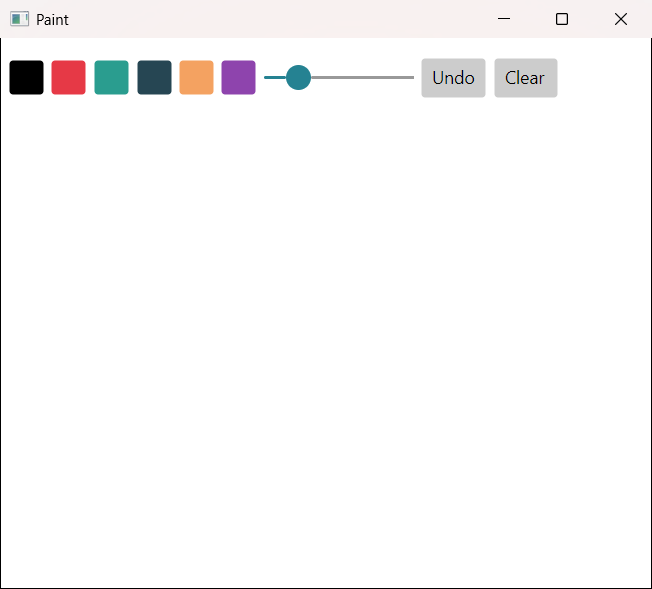
Paint
Paint: draw with the pointer on a canvas; a color, a brush size, undo and clear
cd samples/UsingDotNet/tests/packages/AvaloniaSamples/apps/Paint then ring Paint.ringSource code
# Paint: draw with the pointer on a canvas; a color, a brush size, undo and clear

load "../../avalonia.ring"
avUse()

aColors = ["#000000","#E63946","#2A9D8F","#264653","#F4A261","#8E44AD"]
cColor = "#000000"
nBrush = 6
aStrokes = []          # the shapes of each stroke
lDown = False
oLast = ""

oWindow = avWindow("Paint",520,440)
oDock = new DockPanel()
oWindow.Content = oDock
oBar = avRow(6)
oBar.Margin = avThickness(6)
oDock.SetDock(oBar,"Top")
for nColor = 1 to len(aColors)
	oSwatch = avButton("","pick(" + nColor + ")")
	oSwatch {
		Width = 28
		Height = 28
		Background = avBrush(aColors[nColor])
	}
	oBar.Children.Add(oSwatch)
next
oSize = new Slider()
oSize {
	Minimum = 1
	Maximum = 30
	Value = 6
	Width = 120
	setValueChangedEvent("sizeChanged()")
}
oBar {
	Children.Add(oSize)
	Children.Add(avButton("Undo","undo()"))
	Children.Add(avButton("Clear","clear()"))
}
oCanvas = new Canvas()
oCanvas {
	Background = avBrush("White")
	setPointerPressedEvent("pressed(aDotNetArgs[2].GetPosition(oCanvas))")
	setPointerMovedEvent("moved(aDotNetArgs[2].GetPosition(oCanvas))")
	setPointerReleasedEvent("released()")
}
oDock.Children.Add(oBar)
oDock.Children.Add(oCanvas)

avRun(oWindow)

# --------------------------------------------------------------------------

func pick nColor

	cColor = aColors[nColor]

func sizeChanged

	nBrush = floor(oSize.Value)

# a dot of the brush at a position
func dot oPosition

	oDot = new Ellipse()
	oDot.Width = nBrush
	oDot.Height = nBrush
	oDot.Fill = avBrush(cColor)
	oCanvas.SetLeft(oDot,oPosition.X - nBrush / 2)
	oCanvas.SetTop(oDot,oPosition.Y - nBrush / 2)
	oCanvas.Children.Add(oDot)
	aStrokes[len(aStrokes)][2] += 1

func pressed oPosition

	lDown = True
	aStrokes + [cColor,0]
	dot(oPosition)

func moved oPosition

	if lDown
		dot(oPosition)
	ok

func released

	lDown = False

# the last stroke is removed: its dots are the last children of the canvas
func undo

	if len(aStrokes) = 0
		return
	ok
	nDots = aStrokes[len(aStrokes)][2]
	for nDot = 1 to nDots
		oCanvas.Children.RemoveAt(oCanvas.Children.Count - 1)
	next
	del(aStrokes,len(aStrokes))

func clear

	oCanvas.Children.Clear()
	aStrokes = []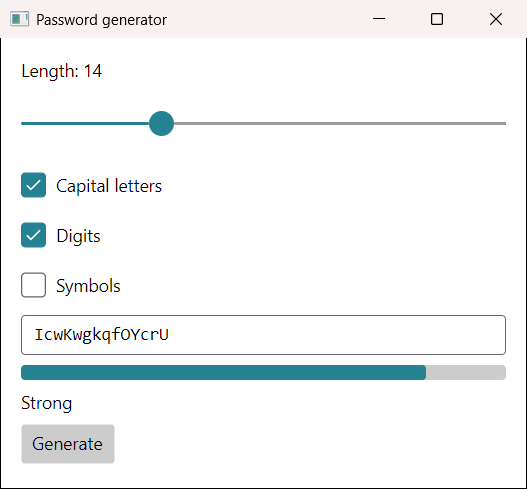
Password Generator
Password generator: the length and the kinds of characters; the strength is shown with a bar
cd samples/UsingDotNet/tests/packages/AvaloniaSamples/apps/PasswordGenerator then ring PasswordGenerator.ringSource code
# Password generator: the length and the kinds of characters; the strength is shown with a bar

load "../../avalonia.ring"
avUse()

cLower = "abcdefghijklmnopqrstuvwxyz"
cUpper = "ABCDEFGHIJKLMNOPQRSTUVWXYZ"
cDigits = "0123456789"
cSymbols = "!@#$%^&*()-_=+"

oWindow = avWindow("Password generator",420,360)
oPanel = avStack(8,16)
oWindow.Content = oPanel
oLength = new Slider()
oLength {
	Minimum = 4
	Maximum = 40
	Value = 14
	setValueChangedEvent("generate()")
}
oLengthText = avText("")
oUpperBox = option("Capital letters",True)
oDigitBox = option("Digits",True)
oSymbolBox = option("Symbols",False)
oPassword = new TextBox()
oPassword.IsReadOnly = True
oPassword.FontFamily = "Consolas, Courier New, monospace"
oStrength = new ProgressBar()
oStrength {
	Minimum = 0
	Maximum = 100
	Height = 12
}
oStrengthText = avText("")
oPanel {
	Children.Add(oLengthText)
	Children.Add(oLength)
	Children.Add(oUpperBox)
	Children.Add(oDigitBox)
	Children.Add(oSymbolBox)
	Children.Add(oPassword)
	Children.Add(oStrength)
	Children.Add(oStrengthText)
	Children.Add(avButton("Generate","generate()"))
}
generate()

avRun(oWindow)

# --------------------------------------------------------------------------

func option cText, lChecked

	oBox = new CheckBox()
	oBox {
		Content = cText
		IsChecked = lChecked
		setIsCheckedChangedEvent("generate()")
	}
	return oBox

# the characters that a password can have with the options that are checked
func alphabet

	cChars = cLower
	if oUpperBox.IsChecked
		cChars += cUpper
	ok
	if oDigitBox.IsChecked
		cChars += cDigits
	ok
	if oSymbolBox.IsChecked
		cChars += cSymbols
	ok
	return cChars

# a password of a length from an alphabet
func makePassword nLength, cChars

	cText = ""
	for nChar = 1 to nLength
		cText += cChars[random(len(cChars) - 1) + 1]
	next
	return cText

# the strength in bits: the length times the bits of one character
func strength nLength, cChars

	return nLength * log(len(cChars)) / log(2)

func generate

	if not isobject(oStrengthText)
		return
	ok
	nLength = floor(oLength.Value)
	cChars = alphabet()
	oLengthText.Text = "Length: " + nLength
	oPassword.Text = makePassword(nLength,cChars)
	nBits = strength(nLength,cChars)
	oStrength.Value = min(100,nBits)
	if nBits < 40
		oStrengthText.Text = "Weak"
	but nBits < 70
		oStrengthText.Text = "Fair"
	else
		oStrengthText.Text = "Strong"
	ok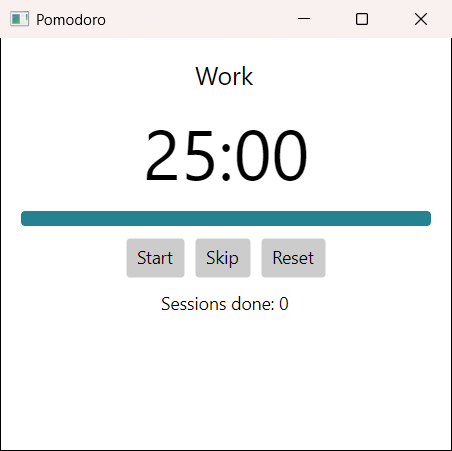
Pomodoro
Pomodoro: work sessions and breaks; the timer counts the seconds, a ring (a ProgressBar) shows the time that is left and the sessions are counted
cd samples/UsingDotNet/tests/packages/AvaloniaSamples/apps/Pomodoro then ring Pomodoro.ringSource code
# Pomodoro: work sessions and breaks; the timer counts the seconds, a ring (a ProgressBar) shows the time that is left and the sessions are counted

load "../../avalonia.ring"
avUse()

nWork = 25 * 60
nShort = 5 * 60
nLong = 15 * 60
cMode = "Work"
nLeft = nWork
nSessions = 0

oWindow = avWindow("Pomodoro",360,330)
oPanel = avStack(10,16)
oWindow.Content = oPanel
oMode = avText("")
oMode.FontSize = 20
oMode.HorizontalAlignment = "Center"
oTime = avText("")
oTime.FontSize = 56
oTime.HorizontalAlignment = "Center"
oBar = new ProgressBar()
oBar {
	Minimum = 0
	Maximum = 100
	Height = 12
}
oCount = avText("")
oCount.HorizontalAlignment = "Center"
oStart = avButton("Start","startPause()")
oRow = avRow(8)
oRow.HorizontalAlignment = "Center"
oRow {
	Children.Add(oStart)
	Children.Add(avButton("Skip","skip()"))
	Children.Add(avButton("Reset","reset()"))
}
oPanel {
	Children.Add(oMode)
	Children.Add(oTime)
	Children.Add(oBar)
	Children.Add(oRow)
	Children.Add(oCount)
}
oTimer = new DispatcherTimer()
oTimer.Interval = dnStatic("System.TimeSpan","FromSeconds",[1])
oTimer.setTickEvent("tick()")
show()

avRun(oWindow)

# --------------------------------------------------------------------------

func two nNumber

	if nNumber < 10
		return "0" + nNumber
	ok
	return "" + nNumber

func lengthOf cWhat

	switch cWhat
	on "Work"
		return nWork
	on "Short break"
		return nShort
	off
	return nLong

func show

	nTotal = lengthOf(cMode)
	oMode.Text = cMode
	oTime.Text = two(floor(nLeft / 60)) + ":" + two(nLeft % 60)
	oBar.Value = nLeft * 100 / nTotal
	oCount.Text = "Sessions done: " + nSessions

# what comes after a mode: after work a short break (a long one after four sessions), after a break work
func nextMode

	if cMode = "Work"
		nSessions++
		if nSessions % 4 = 0
			cMode = "Long break"
		else
			cMode = "Short break"
		ok
	else
		cMode = "Work"
	ok
	nLeft = lengthOf(cMode)

func tick

	nLeft--
	if nLeft <= 0
		nextMode()
	ok
	show()

func startPause

	if oTimer.IsEnabled
		oTimer.Stop()
		oStart.Content = "Resume"
	else
		oTimer.Start()
		oStart.Content = "Pause"
	ok

func skip

	nextMode()
	show()

func reset

	oTimer.Stop()
	cMode = "Work"
	nLeft = nWork
	nSessions = 0
	oStart.Content = "Start"
	show()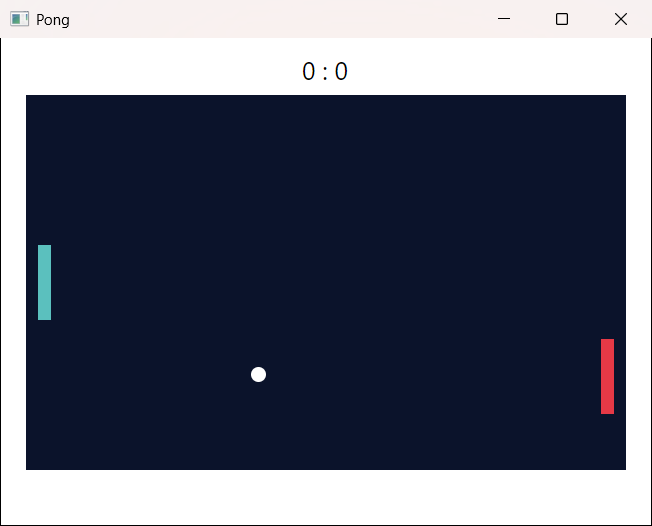
Pong
Pong: you play the left paddle with W and S (or Q and A), the computer plays the right one; the ball speeds up; first to five wins
cd samples/UsingDotNet/tests/packages/AvaloniaSamples/apps/Pong then ring Pong.ringSource code
# Pong: you play the left paddle with W and S (or Q and A), the computer plays the right one; the ball speeds up; first to five wins

load "../../avalonia.ring"
avUse()

nWidth = 480
nHeight = 300
nPaddle = 60
nPlayerY = 120
nComputerY = 120
nBallX = 240
nBallY = 150
nSpeedX = 4
nSpeedY = 2
nPlayerScore = 0
nComputerScore = 0
lOver = False

oWindow = avWindow("Pong",nWidth + 40,nHeight + 90)
oPanel = avStack(6,12)
oWindow.Content = oPanel
oScore = avText("")
oScore.FontSize = 20
oScore.HorizontalAlignment = "Center"
oCanvas = new Canvas()
oCanvas {
	Width = nWidth
	Height = nHeight
	Background = avBrush("#0B132B")
}
oPlayer = shape(10,nPaddle,"#5BC0BE")
oComputer = shape(10,nPaddle,"#E63946")
oBall = new Ellipse()
oBall.Width = 12
oBall.Height = 12
oBall.Fill = avBrush("White")
oCanvas {
	Children.Add(oPlayer)
	Children.Add(oComputer)
	Children.Add(oBall)
}
oPanel {
	Children.Add(oScore)
	Children.Add(oCanvas)
}
oWindow.setKeyDownEvent("keyDown(aDotNetArgs[2].Key)")
oTimer = new DispatcherTimer()
oTimer.Interval = dnStatic("System.TimeSpan","FromMilliseconds",[20])
oTimer.setTickEvent("tick()")
draw()
oTimer.Start()

avRun(oWindow)

# --------------------------------------------------------------------------

func shape nShapeWidth, nShapeHeight, cColor

	oShape = new Rectangle()
	oShape.Width = nShapeWidth
	oShape.Height = nShapeHeight
	oShape.Fill = avBrush(cColor)
	return oShape

func keyDown cKey

	cKey = "" + cKey
	if cKey = "W" or cKey = "Q"
		nPlayerY = max(0,nPlayerY - 24)
	but cKey = "S" or cKey = "A"
		nPlayerY = min(nHeight - nPaddle,nPlayerY + 24)
	but cKey = "Space" and lOver
		nPlayerScore = 0
		nComputerScore = 0
		lOver = False
		serve(1)
	ok

# the ball goes to the center and toward a player (1 the computer, -1 the player)
func serve nDirection

	nBallX = nWidth / 2
	nBallY = nHeight / 2
	nSpeedX = 4 * nDirection
	nSpeedY = random(4) - 2

# the computer follows the ball, a little slower than the ball
func moveComputer

	nCenter = nComputerY + nPaddle / 2
	if nBallY < nCenter - 6
		nComputerY = max(0,nComputerY - 3)
	but nBallY > nCenter + 6
		nComputerY = min(nHeight - nPaddle,nComputerY + 3)
	ok

# one step of the game
func tick

	if lOver
		return
	ok
	moveComputer()
	nBallX += nSpeedX
	nBallY += nSpeedY
	if nBallY <= 0 or nBallY >= nHeight - 12
		nSpeedY = -nSpeedY
	ok
	# the left paddle is at x 10 to 20, the right one at x nWidth - 20 to nWidth - 10
	if nSpeedX < 0 and nBallX <= 20 and nBallX >= 8 and nBallY + 12 >= nPlayerY and nBallY <= nPlayerY + nPaddle
		nSpeedX = -nSpeedX * 1.1
		nSpeedY = (nBallY + 6 - (nPlayerY + nPaddle / 2)) / 8
	but nSpeedX > 0 and nBallX + 12 >= nWidth - 20 and nBallX <= nWidth - 8 and nBallY + 12 >= nComputerY and nBallY <= nComputerY + nPaddle
		nSpeedX = -nSpeedX * 1.1
		nSpeedY = (nBallY + 6 - (nComputerY + nPaddle / 2)) / 8
	ok
	if nBallX < -12
		nComputerScore++
		serve(-1)
	but nBallX > nWidth
		nPlayerScore++
		serve(1)
	ok
	if nPlayerScore >= 5 or nComputerScore >= 5
		lOver = True
	ok
	draw()

func draw

	oCanvas.SetLeft(oPlayer,10)
	oCanvas.SetTop(oPlayer,nPlayerY)
	oCanvas.SetLeft(oComputer,nWidth - 20)
	oCanvas.SetTop(oComputer,nComputerY)
	oCanvas.SetLeft(oBall,nBallX)
	oCanvas.SetTop(oBall,nBallY)
	if lOver
		if nPlayerScore >= 5
			oScore.Text = "You win! " + nPlayerScore + " : " + nComputerScore + " (press Space)"
		else
			oScore.Text = "The computer wins " + nComputerScore + " : " + nPlayerScore + " (press Space)"
		ok
	else
		oScore.Text = "" + nPlayerScore + " : " + nComputerScore
	ok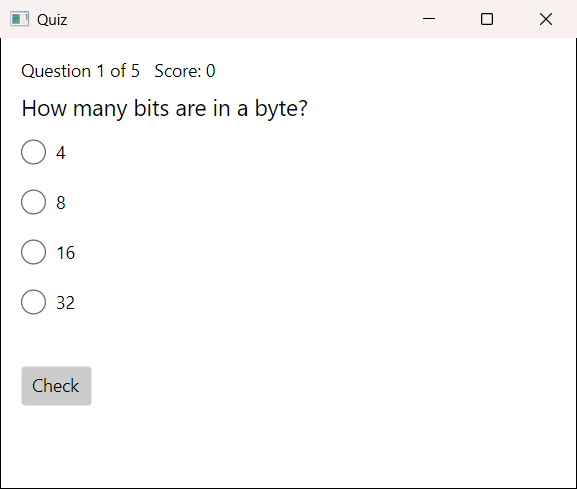
Quiz App
A quiz: a question with four answers (radio buttons), the score, and a result at the end
cd samples/UsingDotNet/tests/packages/AvaloniaSamples/apps/QuizApp then ring QuizApp.ringSource code
# A quiz: a question with four answers (radio buttons), the score, and a result at the end

load "../../avalonia.ring"
avUse()

# [question, [answers], index of the right answer]
aQuestions = [
	["How many bits are in a byte?",["4","8","16","32"],2],
	["Which planet is closest to the Sun?",["Venus","Earth","Mercury","Mars"],3],
	["What is the capital of Egypt?",["Cairo","Alexandria","Giza","Luxor"],1],
	["What is 7 times 8?",["54","56","58","64"],2],
	["Which language is this program written in?",["Python","Ring","Lua","Java"],2]
]
nQuestion = 1
nScore = 0
lAnswered = False

oWindow = avWindow("Quiz",460,360)
oPanel = avStack(8,16)
oWindow.Content = oPanel
oProgress = avText("")
oQuestion = avText("")
oQuestion.FontSize = 18
oQuestion.TextWrapping = "Wrap"
aAnswers = []
for nAnswer = 1 to 4
	oRadio = new RadioButton()
	oRadio.GroupName = "answers"
	aAnswers + oRadio
next
oFeedback = avText("")
oNext = avButton("Check","check()")
oPanel {
	Children.Add(oProgress)
	Children.Add(oQuestion)
}
for oRadio in aAnswers
	oPanel.Children.Add(oRadio)
next
oPanel {
	Children.Add(oFeedback)
	Children.Add(oNext)
}
showQuestion()

avRun(oWindow)

# --------------------------------------------------------------------------

func showQuestion

	aQuestion = aQuestions[nQuestion]
	oProgress.Text = "Question " + nQuestion + " of " + len(aQuestions) + "   Score: " + nScore
	oQuestion.Text = aQuestion[1]
	for nAnswer = 1 to 4
		aAnswers[nAnswer].Content = aQuestion[2][nAnswer]
		aAnswers[nAnswer].IsChecked = False
		aAnswers[nAnswer].IsEnabled = True
	next
	oFeedback.Text = ""
	oNext.Content = "Check"
	lAnswered = False

# the number of the answer that is checked (0 when none is)
func chosen

	for nAnswer = 1 to 4
		if aAnswers[nAnswer].IsChecked
			return nAnswer
		ok
	next
	return 0

func check

	if nQuestion > len(aQuestions)
		restart()
		return
	ok
	if lAnswered
		nQuestion++
		if nQuestion > len(aQuestions)
			finish()
		else
			showQuestion()
		ok
		return
	ok
	nChosen = chosen()
	if nChosen = 0
		oFeedback.Text = "Choose an answer"
		return
	ok
	lAnswered = True
	if nChosen = aQuestions[nQuestion][3]
		nScore++
		oFeedback.Text = "Correct!"
	else
		oFeedback.Text = "Wrong: the answer is " + aQuestions[nQuestion][2][aQuestions[nQuestion][3]]
	ok
	for oRadio in aAnswers
		oRadio.IsEnabled = False
	next
	oProgress.Text = "Question " + nQuestion + " of " + len(aQuestions) + "   Score: " + nScore
	oNext.Content = "Next"

func finish

	oProgress.Text = "Finished"
	oQuestion.Text = "You scored " + nScore + " out of " + len(aQuestions)
	for oRadio in aAnswers
		oRadio.IsVisible = False
	next
	oFeedback.Text = ""
	oNext.Content = "Play again"

func restart

	nQuestion = 1
	nScore = 0
	for oRadio in aAnswers
		oRadio.IsVisible = True
	next
	showQuestion()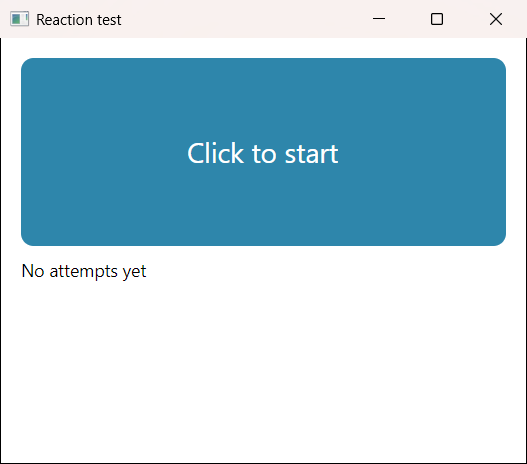
Reaction Test
Reaction test: wait for the red box to turn green and click as fast as you can; clicking too early is a false start; the best time is kept
cd samples/UsingDotNet/tests/packages/AvaloniaSamples/apps/ReactionTest then ring ReactionTest.ringSource code
# Reaction test: wait for the red box to turn green and click as fast as you can; clicking too early is a false start; the best time is kept

load "../../avalonia.ring"
avUse()

dnImport("System.Diagnostics")
cState = "idle"          # idle, waiting, ready, early, result
oWatch = new Stopwatch()
nLast = 0
nBest = 0
nAttempts = 0

oWindow = avWindow("Reaction test",420,340)
oPanel = avStack(10,16)
oWindow.Content = oPanel
oBox = new Border()
oBox {
	Height = 150
	CornerRadius = (new CornerRadius).Parse("10")
	Background = avBrush("#2E86AB")
}
oMessage = avText("Click to start")
oMessage.FontSize = 22
oMessage.Foreground = avBrush("White")
oMessage.HorizontalAlignment = "Center"
oMessage.VerticalAlignment = "Center"
oBox.Child = oMessage
oBox.setPointerPressedEvent("boxClicked()")
oStats = avText("")
oWait = new DispatcherTimer()
oWait.setTickEvent("turnGreen()")
oPanel {
	Children.Add(oBox)
	Children.Add(oStats)
}
showStats()

avRun(oWindow)

# --------------------------------------------------------------------------

func showStats

	if nAttempts = 0
		oStats.Text = "No attempts yet"
	else
		oStats.Text = "Last: " + nLast + " ms   Best: " + nBest + " ms   Attempts: " + nAttempts
	ok

# a click on the box
func boxClicked

	press()

func press

	switch cState
	on "idle"
		startWaiting()
	on "result"
		startWaiting()
	on "early"
		startWaiting()
	on "waiting"
		oWait.Stop()
		cState = "early"
		oBox.Background = avBrush("#E9C46A")
		oMessage.Text = "Too early! Click to try again"
	on "ready"
		oWatch.Stop()
		nLast = oWatch.ElapsedMilliseconds
		nAttempts++
		if nBest = 0 or nLast < nBest
			nBest = nLast
		ok
		cState = "result"
		oBox.Background = avBrush("#2E86AB")
		oMessage.Text = "" + nLast + " ms! Click to try again"
		showStats()
	off

# the box is red; it turns green after a random time of one to three seconds
func startWaiting

	cState = "waiting"
	oBox.Background = avBrush("#C73E1D")
	oMessage.Text = "Wait for green..."
	oWait.Interval = dnStatic("System.TimeSpan","FromMilliseconds",[1000 + random(2000)])
	oWait.Start()

func turnGreen

	oWait.Stop()
	cState = "ready"
	oBox.Background = avBrush("#2A9D8F")
	oMessage.Text = "Click now!"
	oWatch.Reset()
	oWatch.Start()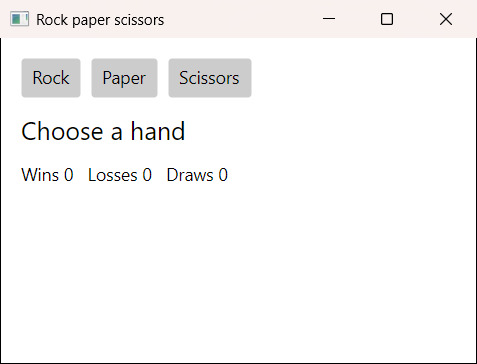
Rock Paper Scissors
Rock, paper, scissors against the computer: three buttons, the choice of the computer, the result and the score
cd samples/UsingDotNet/tests/packages/AvaloniaSamples/apps/RockPaperScissors then ring RockPaperScissors.ringSource code
# Rock, paper, scissors against the computer: three buttons, the choice of the computer, the result and the score

load "../../avalonia.ring"
avUse()

aNames = ["Rock","Paper","Scissors"]
nWins = 0
nLosses = 0
nDraws = 0

oWindow = avWindow("Rock paper scissors",380,260)
oPanel = avStack(12,16)
oWindow.Content = oPanel
oBar = avRow(8)
for nChoice = 1 to 3
	oBar.Children.Add(avButton(aNames[nChoice],"choose(" + nChoice + ")"))
next
oResult = avText("Choose a hand")
oResult.FontSize = 20
oScore = avText("")
oPanel {
	Children.Add(oBar)
	Children.Add(oResult)
	Children.Add(oScore)
}
showScore()

avRun(oWindow)

# --------------------------------------------------------------------------

# 1 beats 3, 2 beats 1, 3 beats 2: the result for the player (1 win, 0 draw, -1 loss)
func outcome nPlayer, nComputer

	if nPlayer = nComputer
		return 0
	ok
	if (nPlayer = 1 and nComputer = 3) or (nPlayer = 2 and nComputer = 1) or (nPlayer = 3 and nComputer = 2)
		return 1
	ok
	return -1

# the player chose a hand, the computer chooses one at random
func choose nPlayer

	chooseAgainst(nPlayer,random(2) + 1)

func chooseAgainst nPlayer, nComputer

	nResult = outcome(nPlayer,nComputer)
	switch nResult
	on 1
		nWins++
		cText = "You win"
	on -1
		nLosses++
		cText = "You lose"
	other
		nDraws++
		cText = "A draw"
	off
	oResult.Text = aNames[nPlayer] + " against " + aNames[nComputer] + ": " + cText
	showScore()

func showScore

	oScore.Text = "Wins " + nWins + "   Losses " + nLosses + "   Draws " + nDraws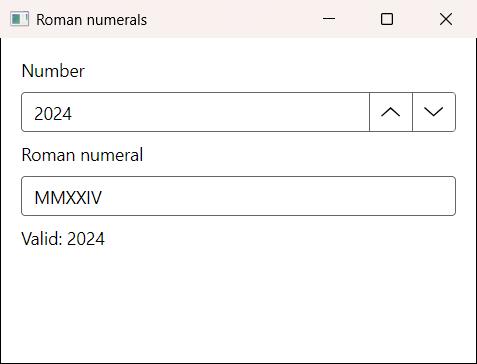
Roman Numerals
Roman numerals: a number from 1 to 3999 becomes a Roman numeral and a Roman numeral becomes a number, as you type
cd samples/UsingDotNet/tests/packages/AvaloniaSamples/apps/RomanNumerals then ring RomanNumerals.ringSource code
# Roman numerals: a number from 1 to 3999 becomes a Roman numeral and a Roman numeral becomes a number, as you type

load "../../avalonia.ring"
avUse()

aValues = [1000,900,500,400,100,90,50,40,10,9,5,4,1]
aSymbols = ["M","CM","D","CD","C","XC","L","XL","X","IX","V","IV","I"]
lBusy = False

oWindow = avWindow("Roman numerals",380,260)
oPanel = avStack(8,16)
oWindow.Content = oPanel
oNumber = new NumericUpDown()
oNumber {
	Minimum = 1
	Maximum = 3999
	Value = 2024
	setValueChangedEvent("numberChanged()")
}
oRoman = new TextBox()
oRoman.setTextChangedEvent("romanChanged()")
oState = avText("")
oPanel {
	Children.Add(avText("Number"))
	Children.Add(oNumber)
	Children.Add(avText("Roman numeral"))
	Children.Add(oRoman)
	Children.Add(oState)
}
numberChanged()

avRun(oWindow)

# --------------------------------------------------------------------------

func toRoman nNumber

	cText = ""
	for nPart = 1 to 13
		while nNumber >= aValues[nPart]
			cText += aSymbols[nPart]
			nNumber -= aValues[nPart]
		end
	next
	return cText

# the number of a Roman numeral, 0 when it is not a valid one (a numeral is valid when it is the numeral of its own number)
func fromRoman cText

	cText = upper(cText)
	nTotal = 0
	nPosition = 1
	nSize = len(cText)
	for nPart = 1 to 13
		while nPosition + len(aSymbols[nPart]) - 1 <= nSize and substr(cText,nPosition,len(aSymbols[nPart])) = aSymbols[nPart]
			nTotal += aValues[nPart]
			nPosition += len(aSymbols[nPart])
		end
	next
	if nPosition <= nSize or nTotal = 0 or toRoman(nTotal) != cText
		return 0
	ok
	return nTotal

func numberChanged

	if lBusy or not isobject(oState)
		return
	ok
	lBusy = True
	oRoman.Text = toRoman(floor(oNumber.Value))
	oState.Text = "Valid"
	lBusy = False

func romanChanged

	if lBusy
		return
	ok
	cText = oRoman.Text
	if not isstring(cText)
		return
	ok
	nValue = fromRoman(cText)
	if nValue > 0
		lBusy = True
		oNumber.Value = nValue
		lBusy = False
		oState.Text = "Valid: " + nValue
	else
		oState.Text = "Not a Roman numeral"
	ok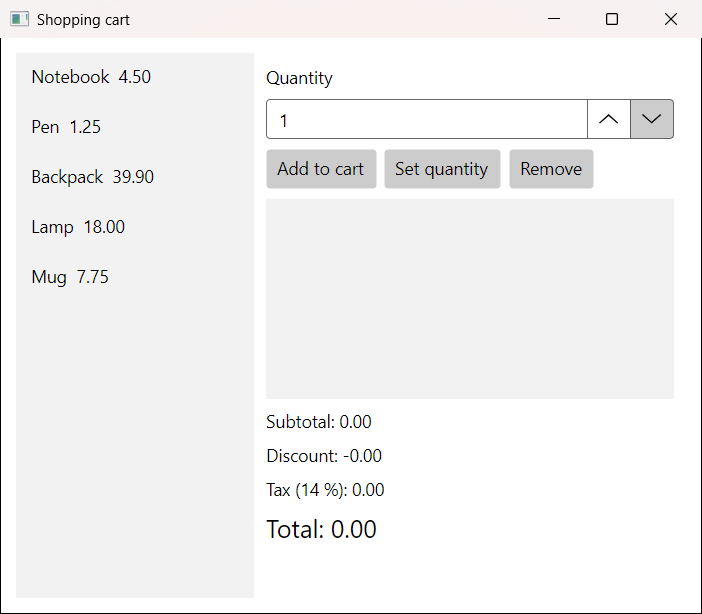
Shopping Cart
A shopping cart: products with prices; add them to the cart, change the quantity, remove them; the subtotal, a discount and the tax give the total
cd samples/UsingDotNet/tests/packages/AvaloniaSamples/apps/ShoppingCart then ring ShoppingCart.ringSource code
# A shopping cart: products with prices; add them to the cart, change the quantity, remove them; the subtotal, a discount and the tax give the total

load "../../avalonia.ring"
avUse()

aProducts = [["Notebook",4.5],["Pen",1.25],["Backpack",39.9],["Lamp",18],["Mug",7.75]]
aCart = []          # [product number, quantity]
nTaxPercent = 14

oWindow = avWindow("Shopping cart",560,460)
oDock = new DockPanel()
oDock.Margin = avThickness(12)
oWindow.Content = oDock
oProducts = new ListBox()
oProducts.Width = 190
for aProduct in aProducts
	oProducts.Items.Add(aProduct[1] + "  " + money(aProduct[2]))
next
oDock.SetDock(oProducts,"Left")
oRight = avStack(8,10)
oCartList = new ListBox()
oCartList.Height = 160
oQuantity = new NumericUpDown()
oQuantity {
	Minimum = 1
	Maximum = 99
	Value = 1
}
oButtons = avRow(6)
oButtons {
	Children.Add(avButton("Add to cart","addToCart()"))
	Children.Add(avButton("Set quantity","setQuantity()"))
	Children.Add(avButton("Remove","removeFromCart()"))
}
oSubtotal = avText("")
oDiscount = avText("")
oTax = avText("")
oTotal = avText("")
oTotal.FontSize = 20
oRight {
	Children.Add(avText("Quantity"))
	Children.Add(oQuantity)
	Children.Add(oButtons)
	Children.Add(oCartList)
	Children.Add(oSubtotal)
	Children.Add(oDiscount)
	Children.Add(oTax)
	Children.Add(oTotal)
}
oDock {
	Children.Add(oProducts)
	Children.Add(oRight)
}
showCart()

avRun(oWindow)

# --------------------------------------------------------------------------

func money nValue

	nCents = floor(nValue * 100 + 0.5)
	nRest = nCents % 100
	cRest = "" + nRest
	if nRest < 10
		cRest = "0" + nRest
	ok
	return "" + floor(nCents / 100) + "." + cRest

func cartIndexOf nProduct

	for nLine = 1 to len(aCart)
		if aCart[nLine][1] = nProduct
			return nLine
		ok
	next
	return 0

func addToCart

	nProduct = oProducts.SelectedIndex + 1
	if nProduct < 1
		return
	ok
	nLine = cartIndexOf(nProduct)
	if nLine > 0
		aCart[nLine][2] += floor(oQuantity.Value)
	else
		aCart + [nProduct,floor(oQuantity.Value)]
	ok
	showCart()

func setQuantity

	nLine = oCartList.SelectedIndex + 1
	if nLine >= 1 and nLine <= len(aCart)
		aCart[nLine][2] = floor(oQuantity.Value)
		showCart()
	ok

func removeFromCart

	nLine = oCartList.SelectedIndex + 1
	if nLine >= 1 and nLine <= len(aCart)
		del(aCart,nLine)
		showCart()
	ok

func subtotal

	nSum = 0
	for aLine in aCart
		nSum += aProducts[aLine[1]][2] * aLine[2]
	next
	return nSum

# 10 percent off for a subtotal of 50 or more
func discountOf nSubtotal

	if nSubtotal >= 50
		return nSubtotal / 10
	ok
	return 0

func showCart

	oCartList.Items.Clear()
	for aLine in aCart
		oCartList.Items.Add("" + aLine[2] + " x " + aProducts[aLine[1]][1] + "  " + money(aProducts[aLine[1]][2] * aLine[2]))
	next
	nSubtotal = subtotal()
	nDiscount = discountOf(nSubtotal)
	nTax = (nSubtotal - nDiscount) * nTaxPercent / 100
	oSubtotal.Text = "Subtotal: " + money(nSubtotal)
	oDiscount.Text = "Discount: -" + money(nDiscount)
	oTax.Text = "Tax (" + nTaxPercent + " %): " + money(nTax)
	oTotal.Text = "Total: " + money(nSubtotal - nDiscount + nTax)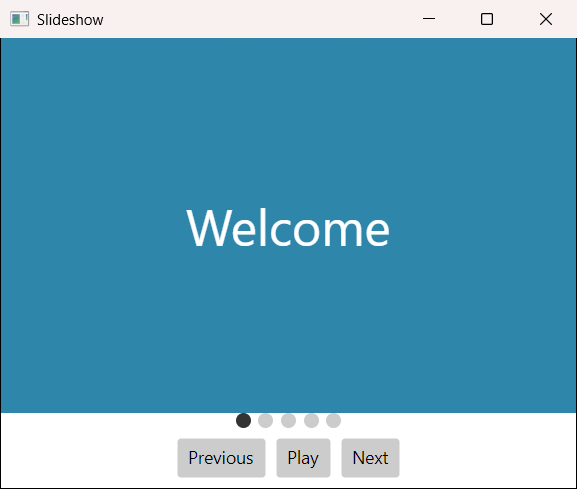
Slideshow
Slideshow: colored slides with titles in a carousel; Play changes the slide with a timer; the dots show where you are
cd samples/UsingDotNet/tests/packages/AvaloniaSamples/apps/Slideshow then ring Slideshow.ringSource code
# Slideshow: colored slides with titles in a carousel; Play changes the slide with a timer; the dots show where you are

load "../../avalonia.ring"
avUse()

aSlides = [["Welcome","#2E86AB"],["Objects","#F18F01"],["Windows","#2A9D8F"],["Events","#8E44AD"],["Thank you","#C73E1D"]]
nSlide = 1

oWindow = avWindow("Slideshow",460,360)
oDock = new DockPanel()
oWindow.Content = oDock
oBar = avRow(8)
oBar.HorizontalAlignment = "Center"
oBar.Margin = avThickness(8)
oPlay = avButton("Play","togglePlay()")
oBar {
	Children.Add(avButton("Previous","previousSlide()"))
	Children.Add(oPlay)
	Children.Add(avButton("Next","nextSlide()"))
}
oDock.SetDock(oBar,"Bottom")
oDots = avRow(6)
oDots.HorizontalAlignment = "Center"
oDock.SetDock(oDots,"Bottom")
aDots = []
for nDot = 1 to len(aSlides)
	oDot = new Ellipse()
	oDot.Width = 12
	oDot.Height = 12
	oDots.Children.Add(oDot)
	aDots + oDot
next
oSlideView = new Border()
oTitle = avText("")
oTitle.FontSize = 40
oTitle.Foreground = avBrush("White")
oTitle.HorizontalAlignment = "Center"
oTitle.VerticalAlignment = "Center"
oSlideView.Child = oTitle
oDock {
	Children.Add(oBar)
	Children.Add(oDots)
	Children.Add(oSlideView)
}
oTimer = new DispatcherTimer()
oTimer.Interval = dnStatic("System.TimeSpan","FromSeconds",[2])
oTimer.setTickEvent("nextSlide()")
showSlide()

avRun(oWindow)

# --------------------------------------------------------------------------

func showSlide

	oTitle.Text = aSlides[nSlide][1]
	oSlideView.Background = avBrush(aSlides[nSlide][2])
	for nDot = 1 to len(aDots)
		if nDot = nSlide
			aDots[nDot].Fill = avBrush("#333333")
		else
			aDots[nDot].Fill = avBrush("#CCCCCC")
		ok
	next

func nextSlide

	nSlide++
	if nSlide > len(aSlides)
		nSlide = 1
	ok
	showSlide()

func previousSlide

	nSlide--
	if nSlide < 1
		nSlide = len(aSlides)
	ok
	showSlide()

func togglePlay

	if oTimer.IsEnabled
		oTimer.Stop()
		oPlay.Content = "Play"
	else
		oTimer.Start()
		oPlay.Content = "Pause"
	ok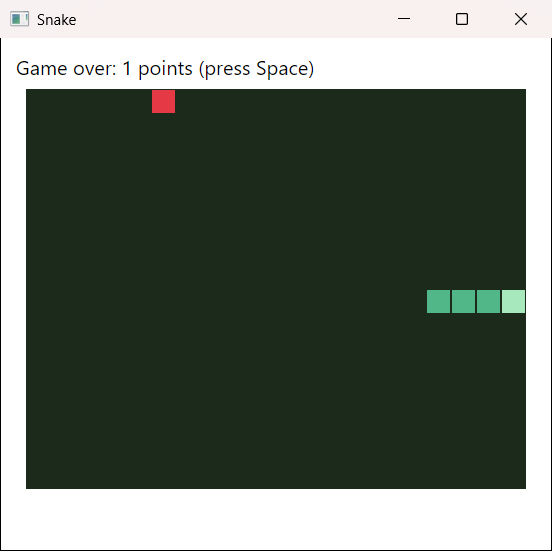
Snake
Snake: the arrow keys (or W A S D) steer the snake, it grows when it eats the food and the game ends when it hits a wall or itself
cd samples/UsingDotNet/tests/packages/AvaloniaSamples/apps/Snake then ring Snake.ringSource code
# Snake: the arrow keys (or W A S D) steer the snake, it grows when it eats the food and the game ends when it hits a wall or itself

load "../../avalonia.ring"
avUse()

nColumns = 20
nRows = 16
nCell = 20
aSnake = []          # [column, row] of each part, the head first
aDirection = [1,0]
aNextDirection = [1,0]
aFood = [0,0]
nScore = 0
lOver = False

oWindow = avWindow("Snake",nColumns * nCell + 40,nRows * nCell + 90)
oPanel = avStack(6,12)
oWindow.Content = oPanel
oCanvas = new Canvas()
oCanvas {
	Width = nColumns * nCell
	Height = nRows * nCell
	Background = avBrush("#1B2A1B")
}
oScore = avText("")
oScore.FontSize = 16
oPanel {
	Children.Add(oScore)
	Children.Add(oCanvas)
}
oWindow.setKeyDownEvent("keyDown(aDotNetArgs[2].Key)")
oTimer = new DispatcherTimer()
oTimer.Interval = dnStatic("System.TimeSpan","FromMilliseconds",[140])
oTimer.setTickEvent("move()")
newGame()
oTimer.Start()

avRun(oWindow)

# --------------------------------------------------------------------------

func newGame

	aSnake = [[10,8],[9,8],[8,8]]
	aDirection = [1,0]
	aNextDirection = [1,0]
	nScore = 0
	lOver = False
	placeFood()
	draw()

# the food goes to a cell that the snake does not cover
func placeFood

	while True
		aFood = [random(nColumns - 1),random(nRows - 1)]
		if not onSnake(aFood[1],aFood[2])
			exit
		ok
	end

func onSnake nColumn, nRow

	for aPart in aSnake
		if aPart[1] = nColumn and aPart[2] = nRow
			return True
		ok
	next
	return False

# the arrow keys; the snake cannot turn back on itself
func keyDown cKey

	switch cKey
	on "Left"
		turn(-1,0)
	on "A"
		turn(-1,0)
	on "Right"
		turn(1,0)
	on "D"
		turn(1,0)
	on "Up"
		turn(0,-1)
	on "W"
		turn(0,-1)
	on "Down"
		turn(0,1)
	on "S"
		turn(0,1)
	on "Space"
		if lOver
			newGame()
		ok
	off

func turn nX, nY

	if aDirection[1] + nX != 0 or aDirection[2] + nY != 0
		aNextDirection = [nX,nY]
	ok

# one step of the snake
func move

	if lOver
		return
	ok
	aDirection = aNextDirection
	nColumn = aSnake[1][1] + aDirection[1]
	nRow = aSnake[1][2] + aDirection[2]
	if nColumn < 0 or nColumn >= nColumns or nRow < 0 or nRow >= nRows or onSnake(nColumn,nRow)
		lOver = True
		draw()
		return
	ok
	insert(aSnake,0,[nColumn,nRow])
	if nColumn = aFood[1] and nRow = aFood[2]
		nScore++
		placeFood()
	else
		del(aSnake,len(aSnake))
	ok
	draw()

func square nColumn, nRow, cColor

	oSquare = new Rectangle()
	oSquare.Width = nCell - 2
	oSquare.Height = nCell - 2
	oSquare.Fill = avBrush(cColor)
	oCanvas.SetLeft(oSquare,nColumn * nCell + 1)
	oCanvas.SetTop(oSquare,nRow * nCell + 1)
	oCanvas.Children.Add(oSquare)

func draw

	oCanvas.Children.Clear()
	square(aFood[1],aFood[2],"#E63946")
	nPart = 0
	for aPart in aSnake
		nPart++
		if nPart = 1
			square(aPart[1],aPart[2],"#A7E8BD")
		else
			square(aPart[1],aPart[2],"#52B788")
		ok
	next
	if lOver
		oScore.Text = "Game over: " + nScore + " points (press Space)"
	else
		oScore.Text = "Score: " + nScore
	ok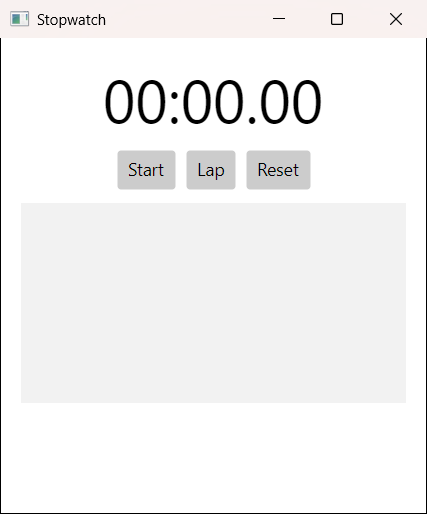
Stopwatch
Stopwatch: start, stop, lap and reset; the time is read from a .NET Stopwatch and shown every 50 milliseconds
cd samples/UsingDotNet/tests/packages/AvaloniaSamples/apps/Stopwatch then ring Stopwatch.ringSource code
# Stopwatch: start, stop, lap and reset; the time is read from a .NET Stopwatch and shown every 50 milliseconds

load "../../avalonia.ring"
avUse()

dnImport("System.Diagnostics")
oWatch = new Stopwatch()
aLaps = []
nLastLap = 0

oWindow = avWindow("Stopwatch",340,380)
oPanel = avStack(10,16)
oWindow.Content = oPanel
oTime = avText("00:00.00")
oTime.FontSize = 48
oTime.HorizontalAlignment = "Center"
oStart = avButton("Start","startStop()")
oLap = avButton("Lap","lap()")
oReset = avButton("Reset","reset()")
oBar = avRow(8)
oBar.HorizontalAlignment = "Center"
oBar {
	Children.Add(oStart)
	Children.Add(oLap)
	Children.Add(oReset)
}
oLaps = new ListBox()
oLaps.Height = 160
oPanel {
	Children.Add(oTime)
	Children.Add(oBar)
	Children.Add(oLaps)
}
oTimer = new DispatcherTimer()
oTimer.Interval = dnStatic("System.TimeSpan","FromMilliseconds",[50])
oTimer.setTickEvent("refresh()")
oTimer.Start()

avRun(oWindow)

# --------------------------------------------------------------------------

# milliseconds as minutes:seconds.hundredths
func formatTime nMilliseconds

	nMinutes = floor(nMilliseconds / 60000)
	nSeconds = floor((nMilliseconds % 60000) / 1000)
	nHundredths = floor((nMilliseconds % 1000) / 10)
	return two(nMinutes) + ":" + two(nSeconds) + "." + two(nHundredths)

func two nNumber

	if nNumber < 10
		return "0" + nNumber
	ok
	return "" + nNumber

func refresh

	oTime.Text = formatTime(oWatch.ElapsedMilliseconds)

func startStop

	if oWatch.IsRunning
		oWatch.Stop()
		oStart.Content = "Start"
	else
		oWatch.Start()
		oStart.Content = "Stop"
	ok

func lap

	nNow = oWatch.ElapsedMilliseconds
	aLaps + nNow
	oLaps.Items.Add("Lap " + len(aLaps) + "   " + formatTime(nNow) + "   (+" + formatTime(nNow - nLastLap) + ")")
	nLastLap = nNow

func reset

	oWatch.Reset()
	oStart.Content = "Start"
	aLaps = []
	nLastLap = 0
	oLaps.Items.Clear()
	refresh()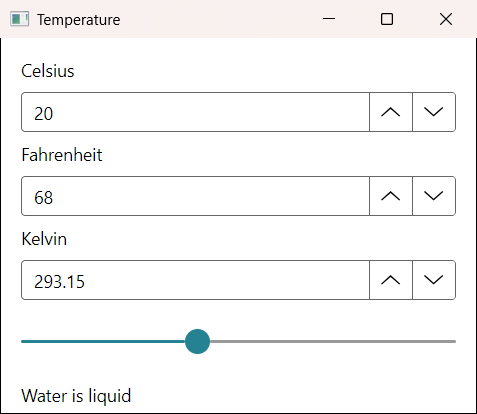
Temperature Converter
Temperature converter: a value in one scale is shown in the other two (Celsius, Fahrenheit, Kelvin); a slider moves the Celsius value
cd samples/UsingDotNet/tests/packages/AvaloniaSamples/apps/TemperatureConverter then ring TemperatureConverter.ringSource code
# Temperature converter: a value in one scale is shown in the other two (Celsius, Fahrenheit, Kelvin); a slider moves the Celsius value

load "../../avalonia.ring"
avUse()

lBusy = False

oWindow = avWindow("Temperature",380,300)
oPanel = avStack(8,16)
oWindow.Content = oPanel
oCelsius = box("Celsius","celsiusChanged()")
oFahrenheit = box("Fahrenheit","fahrenheitChanged()")
oKelvin = box("Kelvin","kelvinChanged()")
oSlider = new Slider()
oSlider {
	Minimum = -100
	Maximum = 200
	Value = 20
	setValueChangedEvent("sliderMoved()")
}
oState = avText("")
oPanel {
	Children.Add(avText("Celsius"))
	Children.Add(oCelsius)
	Children.Add(avText("Fahrenheit"))
	Children.Add(oFahrenheit)
	Children.Add(avText("Kelvin"))
	Children.Add(oKelvin)
	Children.Add(oSlider)
	Children.Add(oState)
}
setCelsius(20)

avRun(oWindow)

# --------------------------------------------------------------------------

func box cName, cCode

	oBox = new NumericUpDown()
	oBox {
		Minimum = -1000
		Maximum = 10000
		Increment = 1
		FormatString = "0.##"
		setValueChangedEvent(cCode)
	}
	return oBox

func toFahrenheit nCelsius

	return nCelsius * 9 / 5 + 32

func toCelsius nFahrenheit

	return (nFahrenheit - 32) * 5 / 9

# all the scales follow a Celsius value (nothing runs again while they are set)
func setCelsius nCelsius

	if lBusy
		return
	ok
	lBusy = True
	oCelsius.Value = nCelsius
	oFahrenheit.Value = toFahrenheit(nCelsius)
	oKelvin.Value = nCelsius + 273.15
	oSlider.Value = nCelsius
	if nCelsius <= 0
		oState.Text = "Water freezes"
	but nCelsius >= 100
		oState.Text = "Water boils"
	else
		oState.Text = "Water is liquid"
	ok
	lBusy = False

func celsiusChanged

	setCelsius(oCelsius.Value)

func fahrenheitChanged

	if not lBusy
		setCelsius(toCelsius(oFahrenheit.Value))
	ok

func kelvinChanged

	if not lBusy
		setCelsius(oKelvin.Value - 273.15)
	ok

func sliderMoved

	if not lBusy
		setCelsius(oSlider.Value)
	ok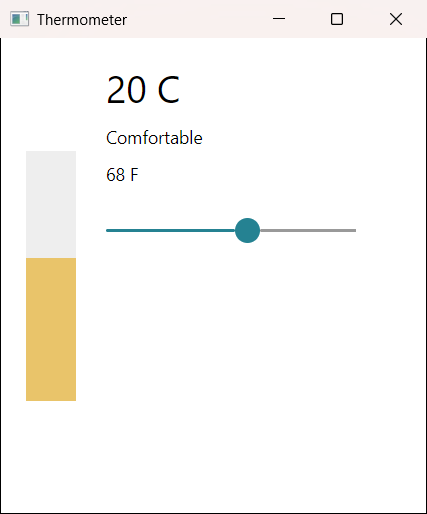
Thermometer
A thermometer: a slider sets the temperature; a tube is filled (a rectangle that grows) and its color goes from blue to red; the state is named
cd samples/UsingDotNet/tests/packages/AvaloniaSamples/apps/Thermometer then ring Thermometer.ringSource code
# A thermometer: a slider sets the temperature; a tube is filled (a rectangle that grows) and its color goes from blue to red; the state is named

load "../../avalonia.ring"
avUse()

nTubeHeight = 200

oWindow = avWindow("Thermometer",340,380)
oPanel = avRow(24)
oPanel.Margin = avThickness(20)
oWindow.Content = oPanel
oTube = new Canvas()
oTube {
	Width = 40
	Height = nTubeHeight
	Background = avBrush("#EEEEEE")
}
oFill = new Rectangle()
oFill.Width = 40
oTube.Children.Add(oFill)
oRight = avStack(10,0)
oSlider = new Slider()
oSlider {
	Minimum = -20
	Maximum = 50
	Value = 20
	Width = 200
	setValueChangedEvent("update()")
}
oDegrees = avText("")
oDegrees.FontSize = 30
oState = avText("")
oFahrenheit = avText("")
oRight {
	Children.Add(oDegrees)
	Children.Add(oState)
	Children.Add(oFahrenheit)
	Children.Add(oSlider)
}
oPanel {
	Children.Add(oTube)
	Children.Add(oRight)
}
update()

avRun(oWindow)

# --------------------------------------------------------------------------

# the color: blue when it is cold, green when it is mild, red when it is hot
func colorOf nCelsius

	if nCelsius < 5
		return "#2E86AB"
	but nCelsius < 18
		return "#2A9D8F"
	but nCelsius < 28
		return "#E9C46A"
	but nCelsius < 38
		return "#F4A261"
	ok
	return "#C73E1D"

func stateOf nCelsius

	if nCelsius < 5
		return "Cold"
	but nCelsius < 18
		return "Cool"
	but nCelsius < 28
		return "Comfortable"
	but nCelsius < 38
		return "Warm"
	ok
	return "Hot"

# the height of the fill for a temperature
func fillHeight nCelsius

	return (nCelsius + 20) / 70 * nTubeHeight

func update

	if not isobject(oFahrenheit)
		return
	ok
	nCelsius = floor(oSlider.Value)
	oDegrees.Text = "" + nCelsius + " C"
	oState.Text = stateOf(nCelsius)
	oFahrenheit.Text = "" + (nCelsius * 9 / 5 + 32) + " F"
	oFill.Height = fillHeight(nCelsius)
	oFill.Fill = avBrush(colorOf(nCelsius))
	oTube.SetTop(oFill,nTubeHeight - oFill.Height)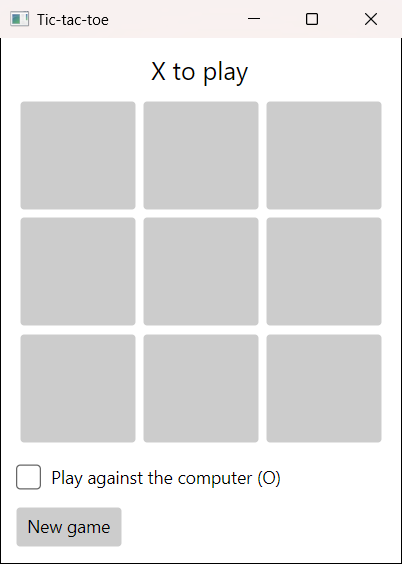
Tic Tac Toe
Tic-tac-toe: two players, or you against the computer (it wins when it can, blocks when it must, then takes the center, a corner, any cell)
cd samples/UsingDotNet/tests/packages/AvaloniaSamples/apps/TicTacToe then ring TicTacToe.ringSource code
# Tic-tac-toe: two players, or you against the computer (it wins when it can, blocks when it must, then takes the center, a corner, any cell)

load "../../avalonia.ring"
avUse()

aBoard = list(9)
cTurn = "X"
lOver = False
aLines = [[1,2,3],[4,5,6],[7,8,9],[1,4,7],[2,5,8],[3,6,9],[1,5,9],[3,5,7]]

oWindow = avWindow("Tic-tac-toe",320,420)
oPanel = avStack(8,12)
oWindow.Content = oPanel
oStatus = avText("X to play")
oStatus.FontSize = 20
oStatus.HorizontalAlignment = "Center"
oGrid = new UniformGrid()
oGrid.Columns = 3
oGrid.Rows = 3
oGrid.Height = 280
aCells = []
for nCell = 1 to 9
	oCell = avButton("","play(" + nCell + ")")
	oCell {
		HorizontalAlignment = "Stretch"
		VerticalAlignment = "Stretch"
		HorizontalContentAlignment = "Center"
		VerticalContentAlignment = "Center"
		FontSize = 40
		Margin = avThickness(3)
	}
	aCells + oCell
	oGrid.Children.Add(oCell)
next
oComputer = new CheckBox()
oComputer.Content = "Play against the computer (O)"
oPanel {
	Children.Add(oStatus)
	Children.Add(oGrid)
	Children.Add(oComputer)
	Children.Add(avButton("New game","newGame()"))
}
newGame()

avRun(oWindow)

# --------------------------------------------------------------------------

func newGame

	for nCell = 1 to 9
		aBoard[nCell] = ""
		aCells[nCell].Content = ""
		aCells[nCell].IsEnabled = True
	next
	cTurn = "X"
	lOver = False
	oStatus.Text = "X to play"

# the player of the turn takes a cell
func play nCell

	if lOver or aBoard[nCell] != ""
		return
	ok
	aBoard[nCell] = cTurn
	aCells[nCell].Content = cTurn
	cWinner = winner()
	if cWinner != ""
		lOver = True
		oStatus.Text = cWinner + " wins!"
		return
	ok
	if full()
		lOver = True
		oStatus.Text = "A draw"
		return
	ok
	if cTurn = "X"
		cTurn = "O"
	else
		cTurn = "X"
	ok
	oStatus.Text = cTurn + " to play"
	if cTurn = "O" and oComputer.IsChecked
		play(computerMove())
	ok

# "X" or "O" when a player has a line, "" when nobody has
func winner

	for aLine in aLines
		cFirst = aBoard[aLine[1]]
		if cFirst != "" and cFirst = aBoard[aLine[2]] and cFirst = aBoard[aLine[3]]
			return cFirst
		ok
	next
	return ""

func full

	for nCell = 1 to 9
		if aBoard[nCell] = ""
			return False
		ok
	next
	return True

# the cell where a player completes a line (0 when there is none)
func completing cPlayer

	for aLine in aLines
		nMine = 0
		nFree = 0
		for nCell in aLine
			if aBoard[nCell] = cPlayer
				nMine++
			but aBoard[nCell] = ""
				nFree = nCell
			ok
		next
		if nMine = 2 and nFree > 0
			return nFree
		ok
	next
	return 0

func computerMove

	nCell = completing("O")
	if nCell = 0
		nCell = completing("X")
	ok
	if nCell = 0 and aBoard[5] = ""
		nCell = 5
	ok
	if nCell = 0
		for nCorner in [1,3,7,9]
			if aBoard[nCorner] = ""
				return nCorner
			ok
		next
	ok
	if nCell = 0
		for nAny = 1 to 9
			if aBoard[nAny] = ""
				return nAny
			ok
		next
	ok
	return nCell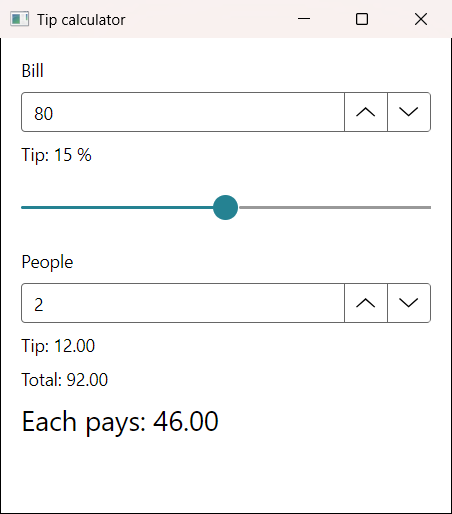
Tip Calculator
Tip calculator: the bill, the tip in percent and the people give the tip, the total and what each person pays
cd samples/UsingDotNet/tests/packages/AvaloniaSamples/apps/TipCalculator then ring TipCalculator.ringSource code
# Tip calculator: the bill, the tip in percent and the people give the tip, the total and what each person pays

load "../../avalonia.ring"
avUse()

oWindow = avWindow("Tip calculator",360,380)
oPanel = avStack(8,16)
oWindow.Content = oPanel
oBill = box(80,0,100000,1)
oPercent = new Slider()
oPercent {
	Minimum = 0
	Maximum = 30
	Value = 15
	setValueChangedEvent("calculate()")
}
oPercentText = avText("")
oPeople = box(2,1,50,1)
oTip = avText("")
oTotal = avText("")
oEach = avText("")
oEach.FontSize = 22
oPanel {
	Children.Add(avText("Bill"))
	Children.Add(oBill)
	Children.Add(oPercentText)
	Children.Add(oPercent)
	Children.Add(avText("People"))
	Children.Add(oPeople)
	Children.Add(oTip)
	Children.Add(oTotal)
	Children.Add(oEach)
}
calculate()

avRun(oWindow)

# --------------------------------------------------------------------------

func box nValue, nMinimum, nMaximum, nStep

	oBox = new NumericUpDown()
	oBox {
		Minimum = nMinimum
		Maximum = nMaximum
		Increment = nStep
		Value = nValue
		setValueChangedEvent("calculate()")
	}
	return oBox

# a number with two decimals
func money nValue

	nCents = floor(nValue * 100 + 0.5)
	nRest = nCents % 100
	cRest = "" + nRest
	if nRest < 10
		cRest = "0" + nRest
	ok
	return "" + floor(nCents / 100) + "." + cRest

func tipOf nBill, nPercent

	return nBill * nPercent / 100

func calculate

	if not isobject(oEach)
		return
	ok
	nPercent = floor(oPercent.Value)
	nTip = tipOf(oBill.Value,nPercent)
	nTotal = oBill.Value + nTip
	oPercentText.Text = "Tip: " + nPercent + " %"
	oTip.Text = "Tip: " + money(nTip)
	oTotal.Text = "Total: " + money(nTotal)
	oEach.Text = "Each pays: " + money(nTotal / oPeople.Value)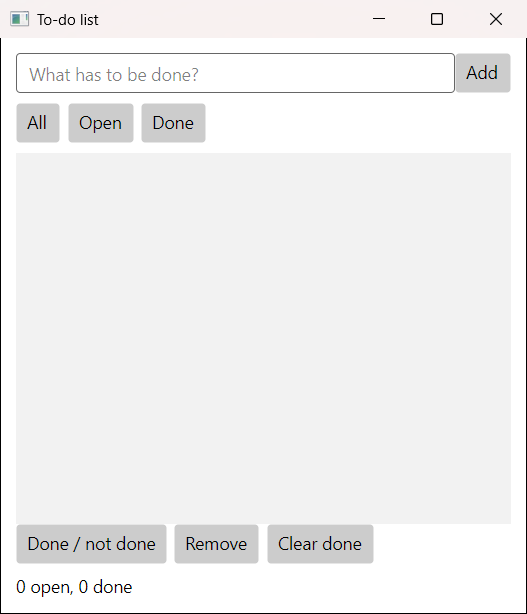
Todo List
A to-do list: add tasks, mark them done, remove them, filter the list; the tasks are kept in a Ring list and shown in a list box
cd samples/UsingDotNet/tests/packages/AvaloniaSamples/apps/TodoList then ring TodoList.ringSource code
# A to-do list: add tasks, mark them done, remove them, filter the list; the tasks are kept in a Ring list and shown in a list box

load "../../avalonia.ring"
avUse()

aTasks = []          # [text, done]
cFilter = "All"

oWindow = avWindow("To-do list",420,460)
oDock = new DockPanel()
oDock.Margin = avThickness(12)
oWindow.Content = oDock

# the row for a new task
oAddRow = new DockPanel()
oAddRow.Margin = avThickness(0)
oAdd = avButton("Add","addTask()")
oAddRow.SetDock(oAdd,"Right")
oNew = new TextBox()
oNew.Watermark = "What has to be done?"
oAddRow {
	Children.Add(oAdd)
	Children.Add(oNew)
}
oDock.SetDock(oAddRow,"Top")

# the filters
oFilters = new StackPanel()
oFilters {
	Orientation = "Horizontal"
	Spacing = 6
	Margin = avMargin(0,8,0,8)
}
for cName in ["All","Open","Done"]
	oFilters.Children.Add(avButton(cName,'setFilter("' + cName + '")'))
next
oDock.SetDock(oFilters,"Top")

# the buttons and the status at the bottom
oStatus = avText("")
oStatus.Margin = avMargin(0,8,0,0)
oDock.SetDock(oStatus,"Bottom")
oActions = new StackPanel()
oActions {
	Orientation = "Horizontal"
	Spacing = 6
}
oActions {
	Children.Add(avButton("Done / not done","toggleTask()"))
	Children.Add(avButton("Remove","removeTask()"))
	Children.Add(avButton("Clear done","clearDone()"))
}
oDock.SetDock(oActions,"Bottom")

oList = new ListBox()
oDock {
	Children.Add(oAddRow)
	Children.Add(oFilters)
	Children.Add(oStatus)
	Children.Add(oActions)
	Children.Add(oList)
}
showTasks()

avRun(oWindow)

# --------------------------------------------------------------------------

func addTask

	cText = oNew.Text
	if not isstring(cText) or trim(cText) = ""
		return
	ok
	aTasks + [trim(cText),False]
	oNew.Text = ""
	showTasks()

# the index in the list of tasks of the selected line (0 when nothing is selected)
func selectedTask

	nLine = oList.SelectedIndex
	if nLine < 0
		return 0
	ok
	nShown = 0
	nTasks = len(aTasks)
	for nTask = 1 to nTasks
		if visible(aTasks[nTask])
			nShown++
			if nShown = nLine + 1
				return nTask
			ok
		ok
	next
	return 0

func toggleTask

	nTask = selectedTask()
	if nTask > 0
		aTasks[nTask][2] = not aTasks[nTask][2]
		showTasks()
	ok

func removeTask

	nTask = selectedTask()
	if nTask > 0
		del(aTasks,nTask)
		showTasks()
	ok

func clearDone

	for nTask = len(aTasks) to 1 step -1
		if aTasks[nTask][2]
			del(aTasks,nTask)
		ok
	next
	showTasks()

func setFilter cName

	cFilter = cName
	showTasks()

# a task that the filter shows
func visible aTask

	return cFilter = "All" or (cFilter = "Open" and not aTask[2]) or (cFilter = "Done" and aTask[2])

# the list box and the status follow the tasks and the filter
func showTasks

	oList.Items.Clear()
	nOpen = 0
	for aTask in aTasks
		if not aTask[2]
			nOpen++
		ok
		if visible(aTask)
			if aTask[2]
				oList.Items.Add("[x] " + aTask[1])
			else
				oList.Items.Add("[ ] " + aTask[1])
			ok
		ok
	next
	oStatus.Text = "" + nOpen + " open, " + (len(aTasks) - nOpen) + " done"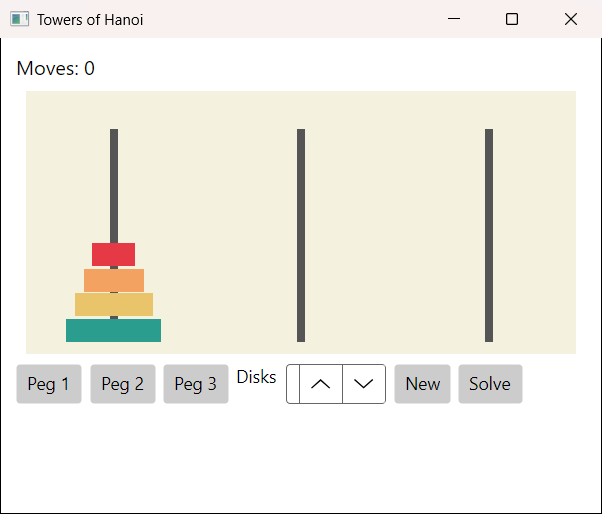
Towers Of Hanoi
Towers of Hanoi: move the disks from the left peg to the right peg, a bigger disk never on a smaller one; Solve shows the shortest way
cd samples/UsingDotNet/tests/packages/AvaloniaSamples/apps/TowersOfHanoi then ring TowersOfHanoi.ringSource code
# Towers of Hanoi: move the disks from the left peg to the right peg, a bigger disk never on a smaller one; Solve shows the shortest way

load "../../avalonia.ring"
avUse()

aPegs = [[],[],[]]          # the disks of each peg, the bottom first (a bigger number is a bigger disk)
nDisks = 4
nMoves = 0
nSelected = 0          # the peg that a disk was picked from (0 when none)
aSolution = []
aColors = ["#E63946","#F4A261","#E9C46A","#2A9D8F","#264653","#8E44AD","#34495E"]

oWindow = avWindow("Towers of Hanoi",480,380)
oPanel = avStack(8,12)
oWindow.Content = oPanel
oInfo = avText("")
oInfo.FontSize = 16
oCanvas = new Canvas()
oCanvas {
	Width = 440
	Height = 210
	Background = avBrush("#F4F1DE")
}
oCount = new NumericUpDown()
oCount {
	Minimum = 1
	Maximum = 7
	Value = 4
	Width = 80
}
oBar = avRow(6)
oBar {
	Children.Add(avButton("Peg 1","pick(1)"))
	Children.Add(avButton("Peg 2","pick(2)"))
	Children.Add(avButton("Peg 3","pick(3)"))
	Children.Add(avText("Disks"))
	Children.Add(oCount)
	Children.Add(avButton("New","newGame()"))
	Children.Add(avButton("Solve","solveGame()"))
}
oPanel {
	Children.Add(oInfo)
	Children.Add(oCanvas)
	Children.Add(oBar)
}
newGame()

avRun(oWindow)

# --------------------------------------------------------------------------

func newGame

	nDisks = floor(oCount.Value)
	aPegs = [[],[],[]]
	for nDisk = nDisks to 1 step -1
		aPegs[1] + nDisk
	next
	nMoves = 0
	nSelected = 0
	showAll()

# a peg is clicked: the first click picks the top disk, the second one drops it
func pick nPeg

	if nSelected = 0
		if len(aPegs[nPeg]) > 0
			nSelected = nPeg
		ok
	else
		moveDisk(nSelected,nPeg)
		nSelected = 0
	ok
	showAll()

# a disk goes from a peg to another when it is not put on a smaller disk
func moveDisk nFrom, nTo

	if nFrom = nTo or len(aPegs[nFrom]) = 0
		return False
	ok
	nDisk = aPegs[nFrom][len(aPegs[nFrom])]
	if len(aPegs[nTo]) > 0 and aPegs[nTo][len(aPegs[nTo])] < nDisk
		return False
	ok
	del(aPegs[nFrom],len(aPegs[nFrom]))
	aPegs[nTo] + nDisk
	nMoves++
	return True

# the moves that solve a tower of n disks: [from, to] pairs
func hanoi nCount, nFrom, nTo, nVia

	if nCount = 0
		return []
	ok
	aMoves = hanoi(nCount - 1,nFrom,nVia,nTo)
	aMoves + [nFrom,nTo]
	aMore = hanoi(nCount - 1,nVia,nTo,nFrom)
	for aMove in aMore
		aMoves + aMove
	next
	return aMoves

# the solution is played from the start
func solveGame

	newGame()
	aSolution = hanoi(nDisks,1,3,2)
	for aMove in aSolution
		moveDisk(aMove[1],aMove[2])
	next
	showAll()

func isWon

	return len(aPegs[3]) = nDisks

func showAll

	oCanvas.Children.Clear()
	for nPeg = 1 to 3
		nCenter = 70 + (nPeg - 1) * 150
		oRod = new Rectangle()
		oRod.Width = 6
		oRod.Height = 170
		oRod.Fill = avBrush("#555555")
		oCanvas.SetLeft(oRod,nCenter - 3)
		oCanvas.SetTop(oRod,30)
		oCanvas.Children.Add(oRod)
		nLevel = 0
		for nDisk in aPegs[nPeg]
			oDisk = new Rectangle()
			oDisk.Width = 20 + nDisk * 14
			oDisk.Height = 18
			oDisk.Fill = avBrush(aColors[nDisk])
			oCanvas.SetLeft(oDisk,nCenter - oDisk.Width / 2)
			oCanvas.SetTop(oDisk,182 - nLevel * 20)
			oCanvas.Children.Add(oDisk)
			nLevel++
		next
	next
	if isWon()
		oInfo.Text = "Solved in " + nMoves + " moves (the best is " + (pow(2,nDisks) - 1) + ")"
	but nSelected > 0
		oInfo.Text = "Moves: " + nMoves + "   Disk picked from peg " + nSelected
	else
		oInfo.Text = "Moves: " + nMoves
	ok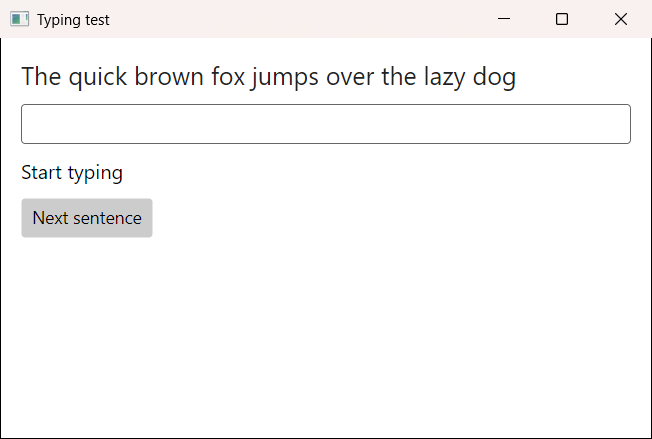
Typing Test
Typing test: a sentence to type; the text turns red at the first mistake; the time and the speed in words a minute are shown when it is finished
cd samples/UsingDotNet/tests/packages/AvaloniaSamples/apps/TypingTest then ring TypingTest.ringSource code
# Typing test: a sentence to type; the text turns red at the first mistake; the time and the speed in words a minute are shown when it is finished

load "../../avalonia.ring"
avUse()

dnImport("System.Diagnostics")
aSentences = [
	"The quick brown fox jumps over the lazy dog",
	"Ring makes small programs that do a lot",
	"A window is a few lines of code with objects",
	"Practice makes the fingers fast and the mind calm"
]
cTarget = ""
nSentence = 0
oWatch = new Stopwatch()
lDone = False

oWindow = avWindow("Typing test",520,320)
oPanel = avStack(10,16)
oWindow.Content = oPanel
oTarget = avText("")
oTarget.FontSize = 20
oTarget.TextWrapping = "Wrap"
oInput = new TextBox()
oInput.setTextChangedEvent("typed()")
oStatus = avText("")
oStatus.FontSize = 16
oPanel {
	Children.Add(oTarget)
	Children.Add(oInput)
	Children.Add(oStatus)
	Children.Add(avButton("Next sentence","nextSentence()"))
}
nextSentence()

avRun(oWindow)

# --------------------------------------------------------------------------

func nextSentence

	nSentence++
	if nSentence > len(aSentences)
		nSentence = 1
	ok
	cTarget = aSentences[nSentence]
	oTarget.Text = cTarget
	oTarget.Foreground = avBrush("#222222")
	oInput.Text = ""
	oStatus.Text = "Start typing"
	oWatch.Reset()
	lDone = False

# the number of characters of the text that are right from the start
func rightChars cText

	nRight = 0
	for nChar = 1 to min(len(cText),len(cTarget))
		if cText[nChar] = cTarget[nChar]
			nRight++
		else
			exit
		ok
	next
	return nRight

# the words a minute: five characters make a word
func wordsPerMinute nCharacters, nSeconds

	if nSeconds <= 0
		return 0
	ok
	return floor(nCharacters / 5 / (nSeconds / 60))

func typed

	if lDone or not isobject(oStatus)
		return
	ok
	cText = oInput.Text
	if not isstring(cText) or cText = ""
		return
	ok
	if not oWatch.IsRunning
		oWatch.Start()
	ok
	nRight = rightChars(cText)
	if nRight < len(cText)
		oTarget.Foreground = avBrush("#C73E1D")
		oStatus.Text = "A mistake at character " + (nRight + 1)
	else
		oTarget.Foreground = avBrush("#222222")
		oStatus.Text = "" + nRight + " of " + len(cTarget) + " characters"
	ok
	if cText = cTarget
		oWatch.Stop()
		lDone = True
		oStatus.Text = "Done! " + wordsPerMinute(len(cTarget),oWatch.ElapsedMilliseconds / 1000) + " words a minute"
	ok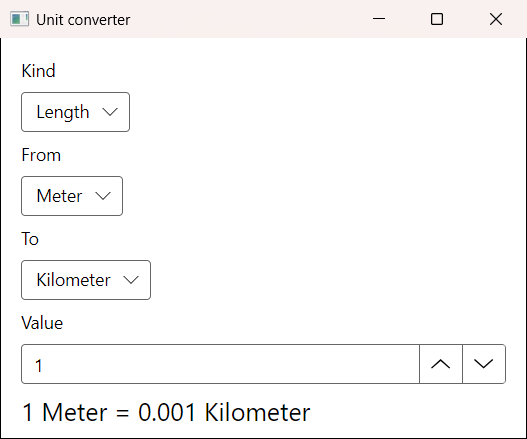
Unit Converter
Unit converter: lengths, weights and volumes; choose the kind, the two units and type a value
cd samples/UsingDotNet/tests/packages/AvaloniaSamples/apps/UnitConverter then ring UnitConverter.ringSource code
# Unit converter: lengths, weights and volumes; choose the kind, the two units and type a value

load "../../avalonia.ring"
avUse()

# each kind has units with their size in the base unit of the kind (meters, grams, liters)
aKinds = [
	["Length",[["Meter",1],["Kilometer",1000],["Centimeter",0.01],["Mile",1609.344],["Foot",0.3048],["Inch",0.0254]]],
	["Weight",[["Gram",1],["Kilogram",1000],["Pound",453.59237],["Ounce",28.349523125]]],
	["Volume",[["Liter",1],["Milliliter",0.001],["Gallon (US)",3.785411784],["Cup (US)",0.2365882365]]]
]
lBusy = False

oWindow = avWindow("Unit converter",420,320)
oPanel = avStack(8,16)
oWindow.Content = oPanel
oKind = new ComboBox()
for aKind in aKinds
	oKind.Items.Add(aKind[1])
next
oFrom = new ComboBox()
oTo = new ComboBox()
oValue = new NumericUpDown()
oValue {
	Minimum = -1000000
	Maximum = 1000000
	Value = 1
	FormatString = "0.######"
}
oResult = avText("")
oResult.FontSize = 20
oPanel {
	Children.Add(avText("Kind"))
	Children.Add(oKind)
	Children.Add(avText("From"))
	Children.Add(oFrom)
	Children.Add(avText("To"))
	Children.Add(oTo)
	Children.Add(avText("Value"))
	Children.Add(oValue)
	Children.Add(oResult)
}
oKind.setSelectionChangedEvent("kindChanged()")
oFrom.setSelectionChangedEvent("convert()")
oTo.setSelectionChangedEvent("convert()")
oValue.setValueChangedEvent("convert()")
oKind.SelectedIndex = 0

avRun(oWindow)

# --------------------------------------------------------------------------

# the units of the kind that is selected fill the two lists
func kindChanged

	if oKind.SelectedIndex < 0
		return
	ok
	lBusy = True
	oFrom.Items.Clear()
	oTo.Items.Clear()
	for aUnit in aKinds[oKind.SelectedIndex + 1][2]
		oFrom.Items.Add(aUnit[1])
		oTo.Items.Add(aUnit[1])
	next
	oFrom.SelectedIndex = 0
	oTo.SelectedIndex = 1
	lBusy = False
	convert()

# the size of a unit in the base unit of its kind
func sizeOf nKind, cUnit

	for aUnit in aKinds[nKind][2]
		if aUnit[1] = cUnit
			return aUnit[2]
		ok
	next
	return 1

func convertValue nKind, cFrom, cTo, nValue

	return nValue * sizeOf(nKind,cFrom) / sizeOf(nKind,cTo)

func convert

	if lBusy or oKind.SelectedIndex < 0 or oFrom.SelectedIndex < 0 or oTo.SelectedIndex < 0
		return
	ok
	nResult = convertValue(oKind.SelectedIndex + 1,oFrom.SelectedItem,oTo.SelectedItem,oValue.Value)
	decimals(6)
	cText = "" + nResult
	decimals(2)
	if substr(cText,".") > 0
		while right(cText,1) = "0"
			cText = left(cText,len(cText) - 1)
		end
		if right(cText,1) = "."
			cText = left(cText,len(cText) - 1)
		ok
	ok
	oResult.Text = "" + oValue.Value + " " + oFrom.SelectedItem + " = " + cText + " " + oTo.SelectedItem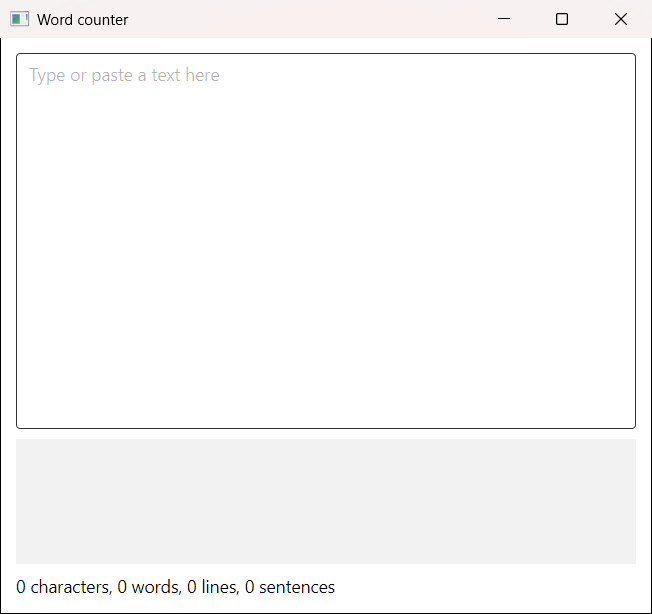
Word Counter
Word counter: type or paste a text; the characters, words, lines, sentences and the most used words are updated as you type
cd samples/UsingDotNet/tests/packages/AvaloniaSamples/apps/WordCounter then ring WordCounter.ringSource code
# Word counter: type or paste a text; the characters, words, lines, sentences and the most used words are updated as you type

load "../../avalonia.ring"
avUse()

oWindow = avWindow("Word counter",520,460)
oDock = new DockPanel()
oDock.Margin = avThickness(12)
oWindow.Content = oDock
oStats = avText("")
oStats.Margin = avMargin(0,8,0,0)
oDock.SetDock(oStats,"Bottom")
oTop = new ListBox()
oTop.Height = 100
oTop.Margin = avMargin(0,8,0,0)
oDock.SetDock(oTop,"Bottom")
oBox = new TextBox()
oBox {
	AcceptsReturn = True
	TextWrapping = "Wrap"
	Watermark = "Type or paste a text here"
	setTextChangedEvent("update()")
}
oDock {
	Children.Add(oStats)
	Children.Add(oTop)
	Children.Add(oBox)
}
update()

avRun(oWindow)

# --------------------------------------------------------------------------

func textOf

	cText = oBox.Text
	if isstring(cText)
		return cText
	ok
	return ""

# the words of a text in lower case (letters and digits and ' make a word)
func wordsOf cText

	aWords = []
	cWord = ""
	for cChar in lower(cText)
		if isalpha(cChar) or isdigit(cChar) or cChar = "'"
			cWord += cChar
		else
			if cWord != ""
				aWords + cWord
				cWord = ""
			ok
		ok
	next
	if cWord != ""
		aWords + cWord
	ok
	return aWords

# the number of sentences: the marks . ! ? that end a text or are followed by a space
func sentencesOf cText

	nSentences = 0
	nSize = len(cText)
	for nChar = 1 to nSize
		if cText[nChar] = "." or cText[nChar] = "!" or cText[nChar] = "?"
			if nChar = nSize or cText[nChar + 1] = " " or cText[nChar + 1] = nl
				nSentences++
			ok
		ok
	next
	return nSentences

# the most used words: [[word, count], ...] with the most used first (words of more than two letters)
func topWords aWords

	aCounts = []
	aIndex = []
	for cWord in aWords
		if len(cWord) > 2
			nAt = find(aIndex,cWord)
			if nAt = 0
				aIndex + cWord
				aCounts + [cWord,1]
			else
				aCounts[nAt][2]++
			ok
		ok
	next
	return sort(aCounts,2)

func update

	if not isobject(oTop)
		return
	ok
	cText = textOf()
	aWords = wordsOf(cText)
	nLines = 0
	if cText != ""
		nLines = len(str2list(cText))
	ok
	oStats.Text = "" + len(cText) + " characters, " + len(aWords) + " words, " + nLines + " lines, " + sentencesOf(cText) + " sentences"
	oTop.Items.Clear()
	aTop = topWords(aWords)
	nTop = len(aTop)
	for nWord = nTop to max(1,nTop - 4) step -1
		oTop.Items.Add(aTop[nWord][1] + ": " + aTop[nWord][2])
	next