ASP.NET Core
A Kestrel web server whose routes are Ring functions — HTML pages, JSON APIs, forms — plus all of the ASP.NET Core classes for everything else.
A web server in a few lines#
load "dotnet.ring"

using { "RingDotNet.Web" }                       # starts the ASP.NET Core mode and loads the web server

oServer = new WebServer("http://localhost:5080")
oServer.onGet("/","home")
oServer.onPost("/api/echo","echo")
oServer.run()                                  # serves until stop()

func home oRequest

	return "<h1>Hello</h1>" + oRequest.path()

func echo oRequest

	return [201,"text/plain","you sent " + oRequest.body()]
using { "RingDotNet.Web" } starts the ASP.NET Core runtime and loads the web server of RingDotNet (it calls dnUseWeb() for you). A handler is a Ring function that receives the request and returns the response.
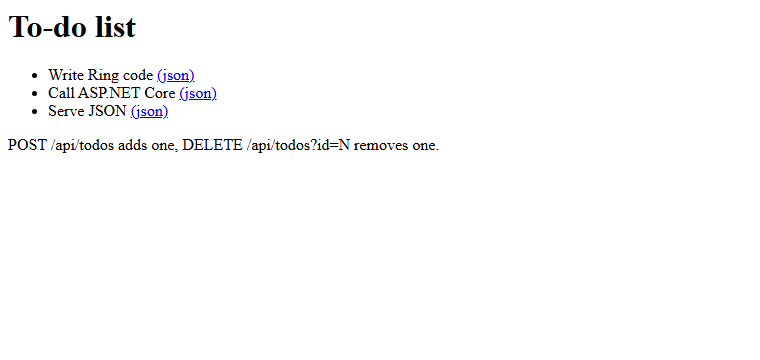
Handlers and responses#
A handler returns one of:
| Return value | Response |
|---|---|
| a text | status 200, text/html |
[status, contentType, text] | exactly that |
webJson(value) | status 200, application/json |
webJson turns a Ring list into a JSON array and a list of [name, value] pairs into a JSON object (nested values too):
func listTodos oRequest

	aList = []
	for aTodo in aTodos
		aList + [["id",aTodo[1]],["text",aTodo[2]]]
	next
	return webJson(aList)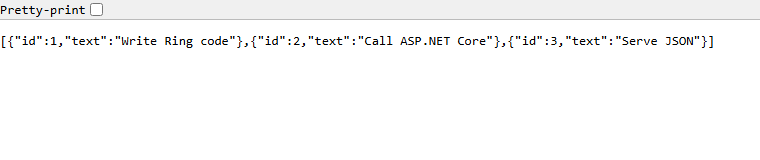
The request#
| Method | Returns |
|---|---|
oRequest.method() | "GET", "POST" ... |
oRequest.path() | /api/todos |
oRequest.queryString() | ?id=1 |
oRequest.query("id") | one query value |
oRequest.body() | the body as text |
oRequest.header("Accept") | a request header |
oRequest.form("name") | a form field of a POST |
oRequest.setHeader(name, value) | add a response header |
oRequest.context() | the ASP.NET HttpContext, for everything else |
The WebServer#
| Method | Does |
|---|---|
new WebServer(url) | starts Kestrel; port 0 picks a free port |
onGet(path, handler), onPost, onPut, onDelete | routes (route(method, path, handler) for any method) |
notFound(handler) | the handler for unknown paths (default: Not found: GET /x) |
url() | the real address (when the port was 0) |
run() | serve until stop() |
serveOne(milliseconds) | handle one waiting request; true if one was handled |
stop(), close() | stop serving, stop the server |
An error raised by a handler becomes a 500 response with the message. nRequests counts the requests served.
One Ring thread#
Kestrel runs on .NET threads and Ring code may only run on the Ring thread. So the requests are queued and serveOne() / run() take them off the queue on the Ring thread. This is the reason you can use any Ring code and global state in a handler without locks — and also why handlers do not run in parallel.
You can mix serving with your own loop (for example next to a GUI: name "System.Windows.Forms" and "RingDotNet.Web" in the same using block, or call dnUseAll()):
while true
	oServer.serveOne(100)          # handle a request if one arrives within 100 ms
	doOtherWork()
end
A complete application#
samples/UsingDotNet/applications/WebApi is a to-do list with a web page and a JSON API. It tests itself by calling its own server with HttpClient:
samples/UsingDotNet/applications/WebApi/WebApi.ring
# A small web application written in Ring on ASP.NET Core: a to-do list with a web page and a JSON API
#   ring WebApi.ring            then open http://localhost:5080/
#   GET /api/todos   POST /api/todos (the text is the body)   DELETE /api/todos?id=1

load "dotnet.ring"

using {
	"System"
	"System.Net.Http"
	"System.Threading.Tasks"
	"RingDotNet.Web"
}

aTodos = []		# [id, text]
nNextId = 1
oServer = ""
oClient = ""
cUrl = ""

func main

	cAddress = "http://localhost:5080"
	if isSelfTest()
		cAddress = "http://127.0.0.1:0"
	ok
	oServer = new WebServer(cAddress)
	oServer.onGet("/","page")
	oServer.onGet("/api/todos","listTodos")
	oServer.onPost("/api/todos","addTodo")
	oServer.onDelete("/api/todos","deleteTodo")
	cUrl = oServer.url()
	if isSelfTest()
		selfTest()
	else
		? "Serving " + cUrl + "  (Ctrl+C to stop)"
		oServer.run()
	ok

func isSelfTest

	return find(sysargv,"--selftest") > 0

# ---------------------------------------------------------------- handlers

func page oRequest

	cHtml = "<html><body><h1>To-do list</h1><ul>"
	for aTodo in aTodos
		cHtml += "<li>" + aTodo[2] + " <a href='/api/todos?id=" + aTodo[1] + "'>(json)</a></li>"
	next
	cHtml += "</ul><p>POST /api/todos adds one, DELETE /api/todos?id=N removes one.</p></body></html>"
	return cHtml

func listTodos oRequest

	aList = []
	for aTodo in aTodos
		aList + [["id",aTodo[1]],["text",aTodo[2]]]
	next
	return webJson(aList)

func addTodo oRequest

	cText = trim(oRequest.body())
	if cText = ""
		return [400,"text/plain","The text of the to-do is empty"]
	ok
	aTodos + [nNextId,cText]
	nNextId++
	return [201,"text/plain","added " + (nNextId - 1)]

func deleteTodo oRequest

	nId = number(oRequest.query("id"))
	for nIndex = 1 to len(aTodos)
		if aTodos[nIndex][1] = nId
			del(aTodos,nIndex)
			return [200,"text/plain","deleted " + nId]
		ok
	next
	return [404,"text/plain","There is no to-do " + nId]

# ---------------------------------------------------------------- self test: a .NET client talks to the server

func request cMethod, cPath, cBody

	oMessage = new HttpRequestMessage().@New([ :method = new HttpMethod(cMethod), :requestUri = cUrl + cPath ])
	if cBody != ""
		oMessage.Content = new StringContent(cBody)
	ok
	oClient = new HttpClient()
	oTask = oClient.SendAsync(oMessage)
	for nTry = 1 to 50
		if oServer.serveOne(100)
			exit
		ok
	next
	oTask.Wait(NULL)
	oResponse = oTask.Result
	oBody = oResponse.Content.ReadAsStringAsync(NULL)
	oBody.Wait(NULL)
	return [statusNumber(oResponse.StatusCode),oBody.Result]

# enums are strings: the status names the example uses
func statusNumber cName

	switch cName
	on "OK"			return 200
	on "Created"		return 201
	on "BadRequest"		return 400
	on "NotFound"		return 404
	off
	return 0

func selfTest

	aResult = request("GET","/api/todos","")
	dnAssert("empty list",aResult[2],"[]")
	aResult = request("POST","/api/todos","write Ring code")
	dnAssert("created",aResult[1],201)
	request("POST","/api/todos","call ASP.NET")
	aResult = request("POST","/api/todos","   ")
	dnAssert("empty text is a 400",aResult[1],400)
	aResult = request("GET","/api/todos","")
	dnAssert("the JSON list",aResult[2],'[{"id":1,"text":"write Ring code"},{"id":2,"text":"call ASP.NET"}]')
	aResult = request("DELETE","/api/todos?id=1","")
	dnAssert("deleted",aResult[2],"deleted 1")
	aResult = request("DELETE","/api/todos?id=9","")
	dnAssert("missing is a 404",aResult[1],404)
	aResult = request("GET","/","")
	dnAssert("the web page lists the to-do",substr(aResult[2],"call ASP.NET") > 0,True)
	oServer.close()
	? "SELFTEST " + iif(nDotNetFail = 0,"OK (" + nDotNetPass + " checks)","FAILED")

func iif lCondition, xYes, xNo

	if lCondition
		return xYes
	ok
	return xNo
All of ASP.NET Core#
The ASP.NET Core classes are wrapped too: Microsoft.AspNetCore.* (Http, Routing, Authentication, Authorization, Mvc, Builder, Hosting, StaticFiles...), Microsoft.Extensions.* (DependencyInjection, Configuration, Logging, Hosting, Caching...) and Microsoft.Net.Http.Headers. Class names that clash with other namespaces start with Asp. Extension methods (AddSingleton, AddAuthentication, BuildServiceProvider...) are methods of the classes that they extend (Core concepts).
using { "Microsoft.AspNetCore.Http" }

oPath = new PathString().@New([ :value = "/api/items" ])
? oPath.Value                                   # /api/items
? oPath.StartsWithSegments(new PathString().@New([ :value = "/api" ]))

oQuery = new QueryString().Create([ :name = "name", :value = "ring dotnet" ])
? oQuery.Value                                  # ?name=ring%20dotnet
What is not supported#
- MVC controllers and Razor pages written in C# — the web server is the Ring one.
- Handlers that run in parallel (there is one Ring thread).
- Calling Ring from middleware you wrote in .NET.
Where to go next#
- Entity Framework Core: the database side of a web program.
- The tutorial chapters Networking and the web and Security.